Sunday, August 8, 2021

Lammas - First Harvest

    Lammas, also called Lughnasadh, is the first of the three harvest celebrations of the year, the other two being Autumn Equinox and Halloween.  In Middle English, the celebration was called Lammasse, meaning "loaf mass", and was a Church holiday on which the first loaves of bread from that year's grain were consecrated.  Another name for Lammas is Lughnasadh, a harvest celebration particular to Ireland, Scotland, and the Isle of Man.  In the story of this holiday, the god Lugh fights to steal the grain for humanity and avoid the blight that would ruin the harvest and starve the people.

    At our house, this holiday has gained in importance as our gardens have grown in size.  We have a small altar in the back of our property on which we have placed offerings of this year's first produce  You can see a summer squash, green garlic, and a small sheaf of wheat I harvested at the Low Technology Institute https://lowtechinstitute.org.  

    It's considered bad luck to start the harvest season with last year's grain, so I managed to grab a few wheat stalks at the Low Technology Institute when I was co-teaching a class on flax processing and spinning with Scott Johnson, the head of the Low Technology Institute.  Scott grows and mills his own wheat on a small homestead in Cooksville, Wisconsin, and he showed me a couple of his beautiful wheat sheaves.         

 The garden gate at the  Low Technology Institute     


 Lammas is a time for assessing the progress of planting and for celebrating the abundance still to come.  In the spirit of the celebration, here is a tour of the progress of our gardens and other projects we started this spring.  But before we begin, I must tell you a bit about the harvest loaf.  

    Each year, we bake a harvest loaf for Lammas.  Sometimes it's a rounded braid, sometimes it's a perfect sourdough loaf; sometimes it's in the shape of a sheaf of wheat, sometimes like a corn dolly or an abundant goddess figure.  This year Harvest did the honors by making beautiful focaccia bread decorated with tomatoes, squash blossoms, basil, and garlic scapes, all from our own garden.

                                  Share the harvest loaf with us as you take a tour.
                                                      

Thanks to well-composted chicken straw (thank you, ladies!) and Harvest's loving care, we are on the verge of a vegetable explosion.  Harvest doubled the size of the garden this spring and put tomatoes on "her" side with a few pepper plants that I was allowed to put into an unused corner. I put in quite a few non-tomato veggies on "my" side, but the squash is climbing every available surface, including fencing.   Although I have a lovely diagram telling me where everything should be, the squash has had other ideas this year, and I can't tell what's where anymore.  I brought in what I thought was a not quite ripe squash to cut up for dinner.  It was unbelievably bitter.  I couldn't figure out why until I realized  later that it must have been an unripe melon instead.  Even the best laid plans, or in this case, the best drawn diagrams, are of no use when the squash goes berserk. And yes, I know that squash has a tendency to do this, but this is becoming squashmageddon.  Somewhere underneath the squash vines, the broccoli and broccolini are hiding. I've seen glimpses of the blue-green leaves, but I can't get to them for the squash vines, and there's something in me that just can't cut back a vine that has blossoms and potential fruit on it.  Good thing the broccoli and broccolini are cool weather crops.  The squash leaves are keeping them cool, and they should be visible when the squash vines start to die back.  I hope.  


    This happy chappie is a Candy Roaster squash.  It's a great keeper, but does get large.  It's the size of a miniature poodle now, but this one promises to be the side of a toddler when it's all grown up.  I have no idea how I'm going to carry it inside much less where I'll put it.

    The peppers and sunflowers are coming along.   I had hoped to plant a Hungarian pepper variety so that I could make my own paprika, but the plants didn't make it though the indoor planting stage, and it was too late to start over, so I've settled for some Louisiana peppers that are supposed to be both hot and sweet.  I'm going to let them ripen to deep red, which should mellow them somewhat, then dry them, hoping they will give a little kick to dishes without overwhelming heat.

    Because we had cedar apple  rust on our apple threes, we decided to cut two of the three down to about  four feet in height.  When apples trees are planted too close to cedar trees, there's nothing that can be done about it except to remove the cedar trees, which, unfortunately, are on the neighbor's property.  We didn't know about it when we planted the apple trees and didn't figure it out for years.  The apple trees had to go.

    We left one tree up for shade, knowing that any apples it did manage to grow would be inedible, and we took down the other two leaving tall stumps as handy places to put tools.  We planted a charming little flower bed around the stump in Harvest's side of the garden.  As you can see, the apple trees, like the squash, have had other plans.  The trimming, vicious at it was, seems to have encouraged them.  I think this one makes a charming little topiary, and perhaps we'll get a good crop of apples from it next year.

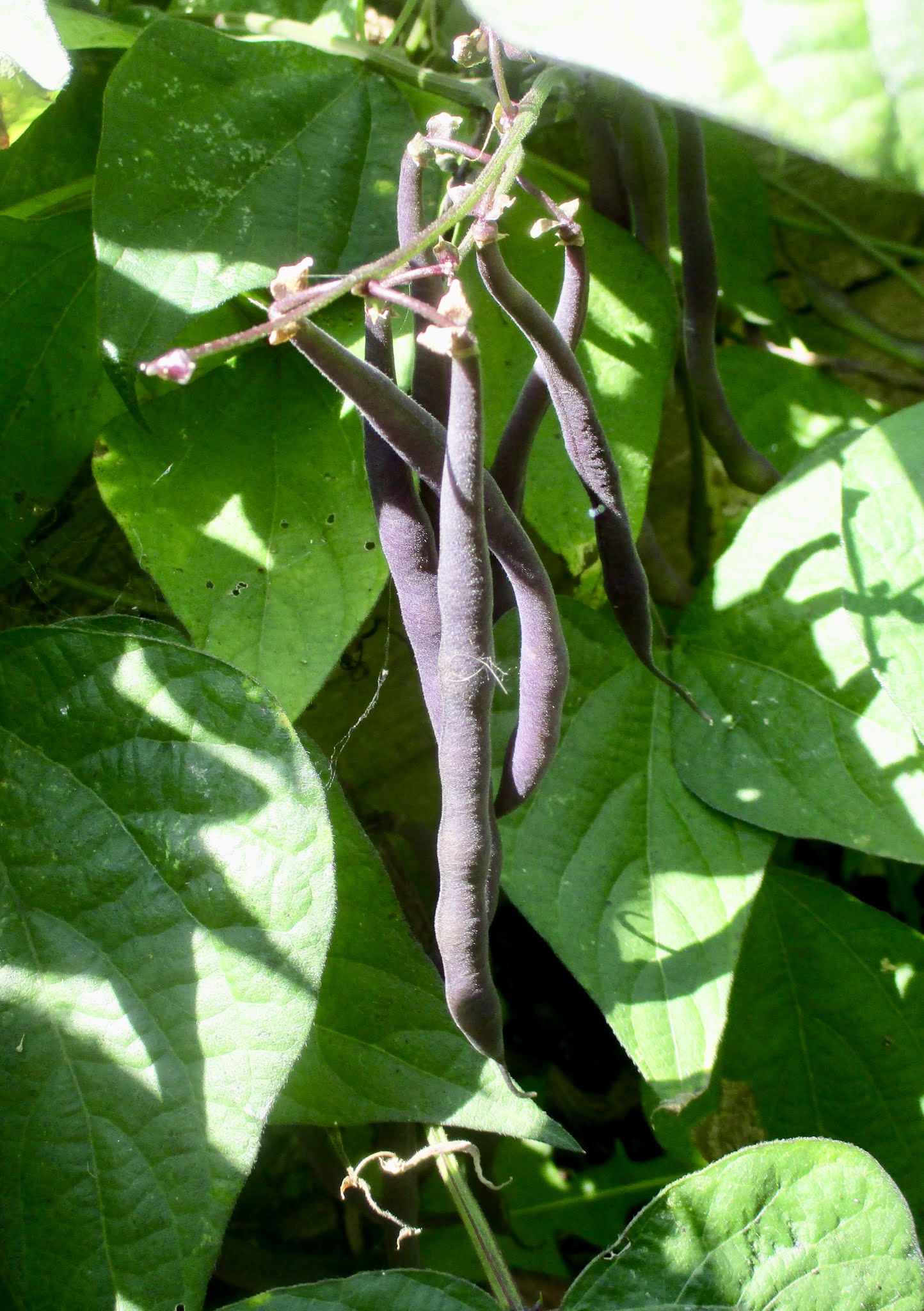
    Meanwhile in the raised beds in the front of the house, the beans have been harvested.  


    These are purple-podded bush beans.  They're easier to harvest because they're more visible, but they're not as crunchy as we would like, and their window of harvest time is very narrow - just a few days - so we've frozen them, and Harvest has planted a second crop of the faithful Blue Lake beans.  They're coming up like troopers, and it looks like we'll have beans by late September or so.  


Next to the house in the front yard, the dark red hibiscus are blooming profusely.  If you look at the photo, you'll see the railing of the front porch, and you can see how huge the flowers are.  The smallest ones are the size of a luncheon plate.  The dark red flowers are perfect for dyeing wool, which is why I bought a plant.   It gets bigger every year, but who could complain with a show like this.  Because they only last a day or so, they have to be harvested and dried the moment they start to wilt.  On the other hand, they give us an ever-changing view as the flowers come and go on various parts of the plant.
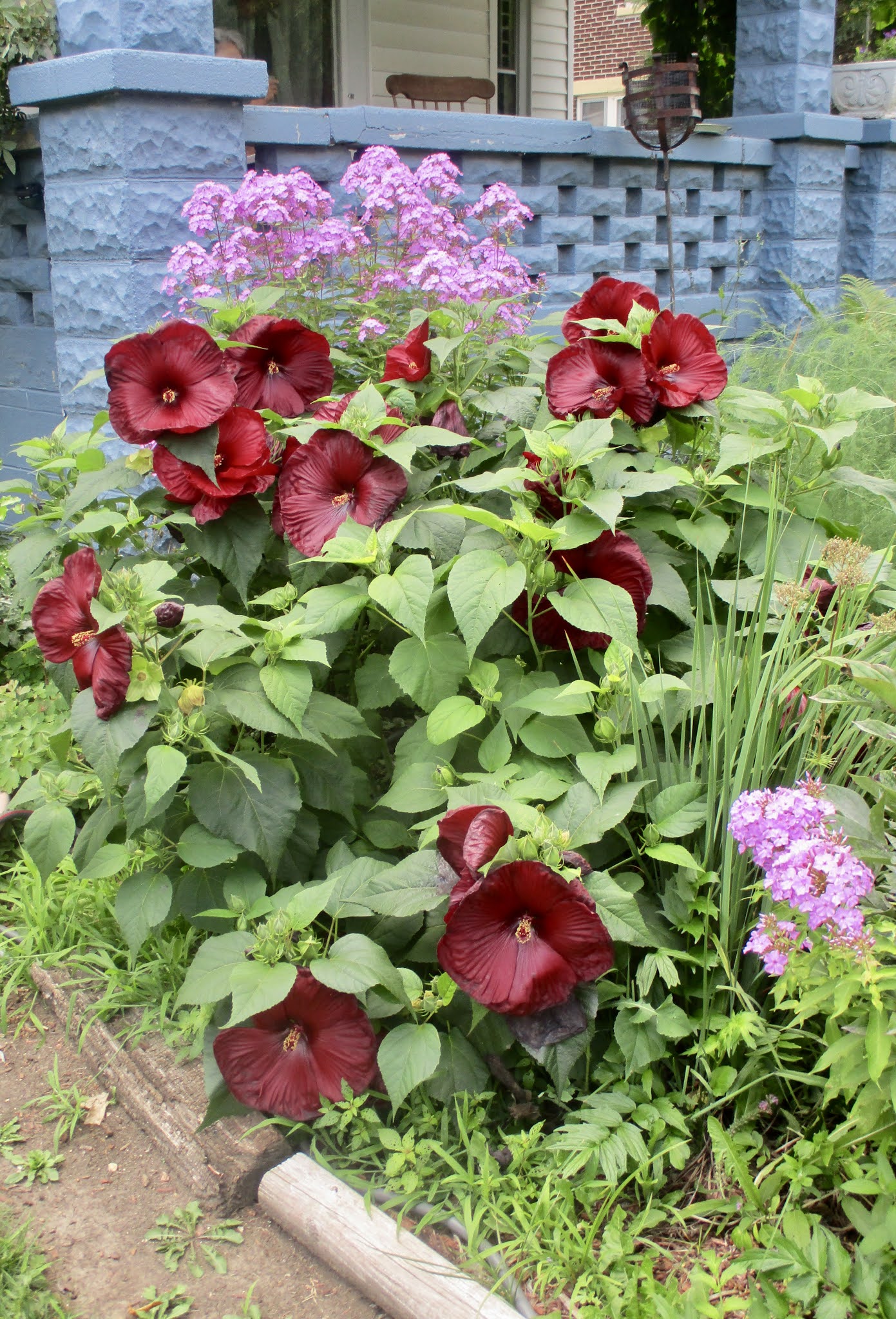
Enormous hibiscus next to the porch.

    And in the chicken coop, all is well at last.  Those cute little fluffballs that turned into ungainly teenagers have finally turned into hens, and they should start laying eggs around mid-September.  We've been hoarding the eggs we do get at the moment because we only get two from the Prairie Blue Eggers, Isis and Judy, and a small one from Elizabeth who, after months of not laying a single egg, decided to come back into lay, thereby saving herself from a trip to another home.

                                            The "little" girls.  Left to right: Hattie, Shirley, Barbara, and Goldie

    Everyone sleeps in the coop now, and though each group tends to stick together, there are no more scraps, and they all spend time peaceably in the yard together.        

                Little girls to the left, big girls to the right.

Having been raised by hand, the "little girls", as I call the former chicks, entertain themselves by following me around.  This sounds like a brilliant idea until you realize that they are following you down the driveway toward the street.  And, of course, each group has their own way of getting into mischief in two separate areas of the yard, naturally, which involves shooing one group away from where they shouldn't be, then going to find the other group and what trouble they've got into.  Meanwhile the first group... you get the idea.  I had a notion at one point to sit in the yard and read with the chickens pecking around nearby.  It didn't happen.  On the other hand, Barbie and Hattie like to be petted and held, so that makes up for it a little.

    As the harvest time continues, there will doubtless be more tales to tell.  Meanwhile, I will leave you with the sound of cicadas.  The sound starts almost like a cricket and then rises to what I can only describe as a "shiver" before subsiding again.  For those of you who have never heard the sound before, it is surreal, and it means that summer is beginning to wane and autumn will be arriving before we know it. https://soundbible.com/920-Cicada.html


Friday, July 23, 2021

July 4th - I Love A Parade!*

       Who doesn't love a parade?  Whether they are living in Ancient Rome, Medieval Japan, Renaissance England, Los Angeles, or New York City, humans just love to strut their stuff, and if they can do it in groups with observers watching their every move, so much the better.  Come to think of it, can a parade really be called a parade if there's no one on the sidelines to watch it?  
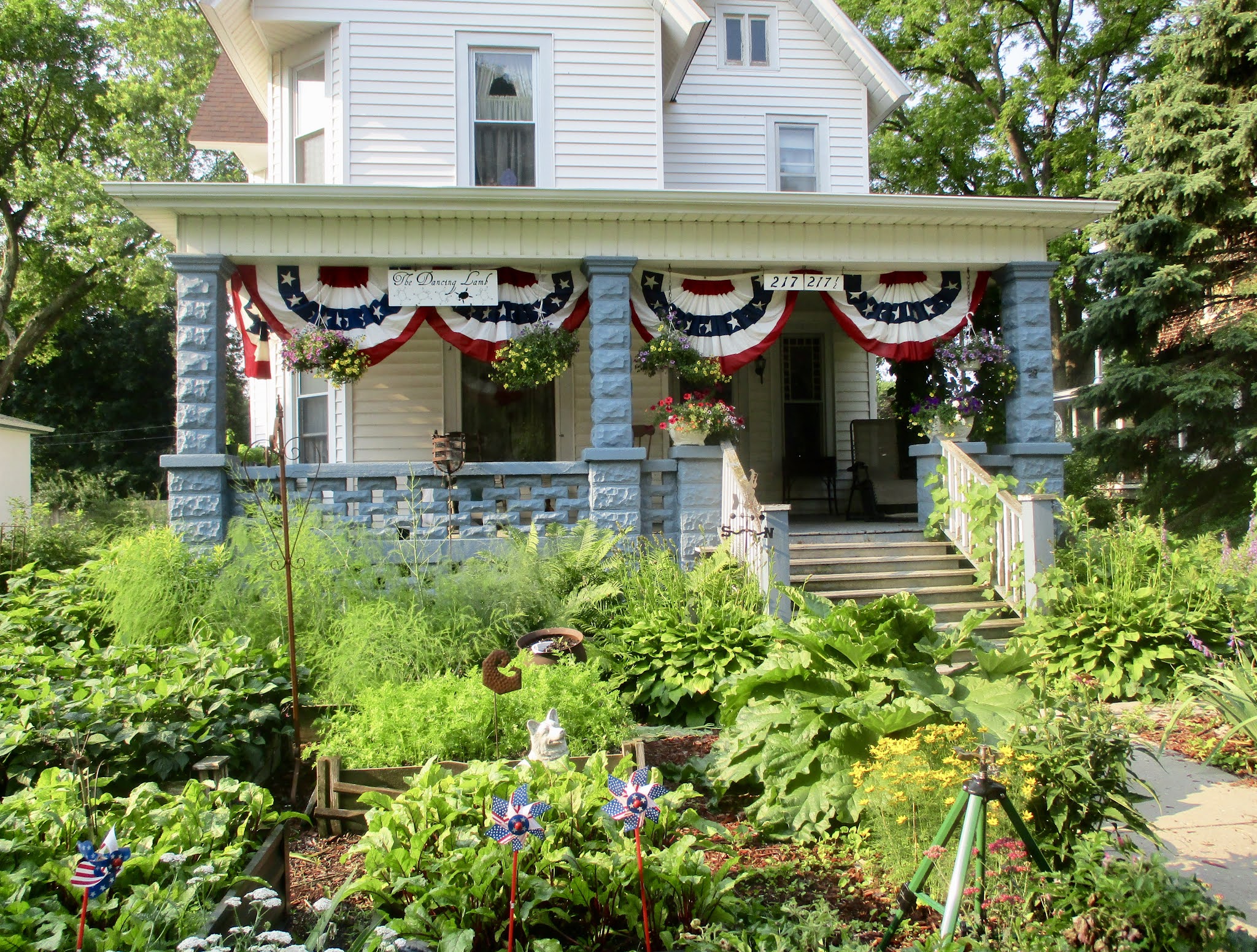
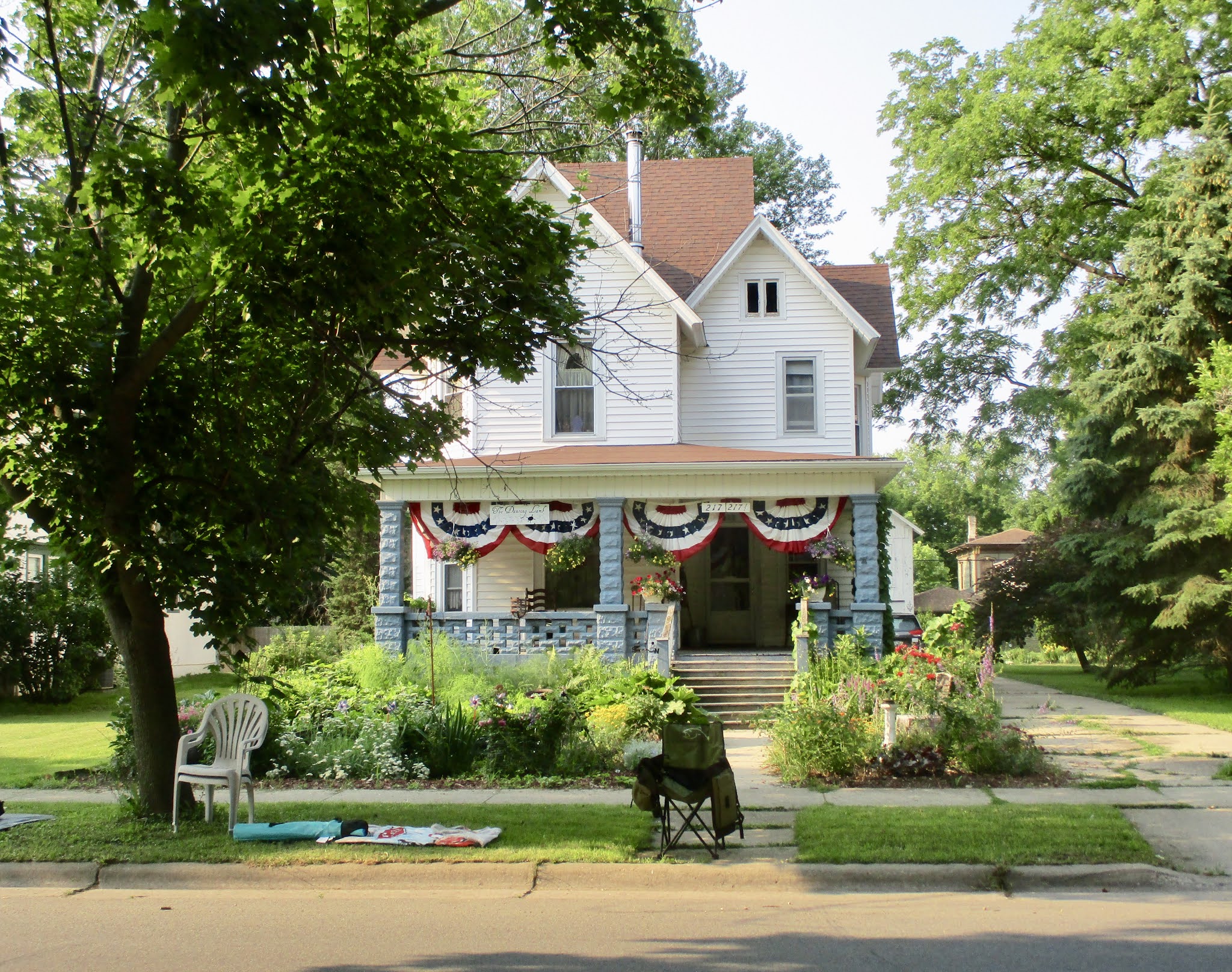
    As always, Harvest decorates the front porch with real fabric bunting, and this year she bought little stars-n-stripes pinwheels to stick into the raised beds in the front garden.  Since there had been no official parade last year due to COVID, everyone was in high spirits this year and wanted to secure their preferred spot as soon as they could.   In years past, this has involved putting a blanket or chairs down on the "terrace" of grass between the sidewalk and the street the evening before the parade.  This year, however, the claim staking (with real stakes at times) was in full swing by midmorning of the day before the parade.  

   Being the little Norman-Rockwell-meets-Mayberry-RFD-meets-Currier-&-Ives town that it is, Evansville is no slouch when it comes to parades.  Evansville is a town that is close enough to Madison, Wisconsin to be within commuting distance of the city, but it is surrounded by farmland for miles in any direction, and our parade has a distinctive small town feel to it without being artificial.  The floats are often pulled by tractors, and some of the participants include things like the local karate kids trying to look as fearsome as possible while running through their training routines as they punch and kick their way down the street.  The local dance academy has a float.  The kids' roller hockey team skates down the street in a kind of mock game which appears to be missing sticks.

    As with all proper July 4th parades, the military color guard leads the way.  We all stand respectfully as they pass.  As they go by, the oldest veterans look even older, and the Vietnam Vets have long since turned grey.  Now there are men and women marching down the street who are much younger than I am.  There are not many of these vets, probably just a little over 20 in all, but in a town this small, that's a significant number.

    Following on the heels of the veterans are the fire trucks.  This is either a way for residents to see that their taxes pay for some really cool emergency kit, or it's for the kids (usually little boys of about two) to jump up and down, pointing and saying, "Truck!  Truck!  Truck!"  Or both.  The hook and ladder engines are some of the most impressive, but ambulances, tankers, and emergency vehicles of all kinds from nearby towns roll down the street, all bright and shiny and looking like they've never been within six miles of a fire.  It's a longstanding tradition that the firefighters, paramedics, and whoever else is riding on the vehicles toss candy almost continuously to the people lining the streets to watch.

    And what would a parade be without horses?  Bo, the black Percheron who pulls the carriage for the Evansville Carriage Company (see the post "The Surrey With the Fringe on Top") was ridden by his owner, Camille Skotnicki, with two of the other horses who are in the same barn.   It's hard to get a feel for how enormous Bo really is, but Camille looks like a child riding him, and she's a full-grown woman.  He's a big, big boy.  And a very handsome fellow he was, too. 


Another riding group followed a short time later.    


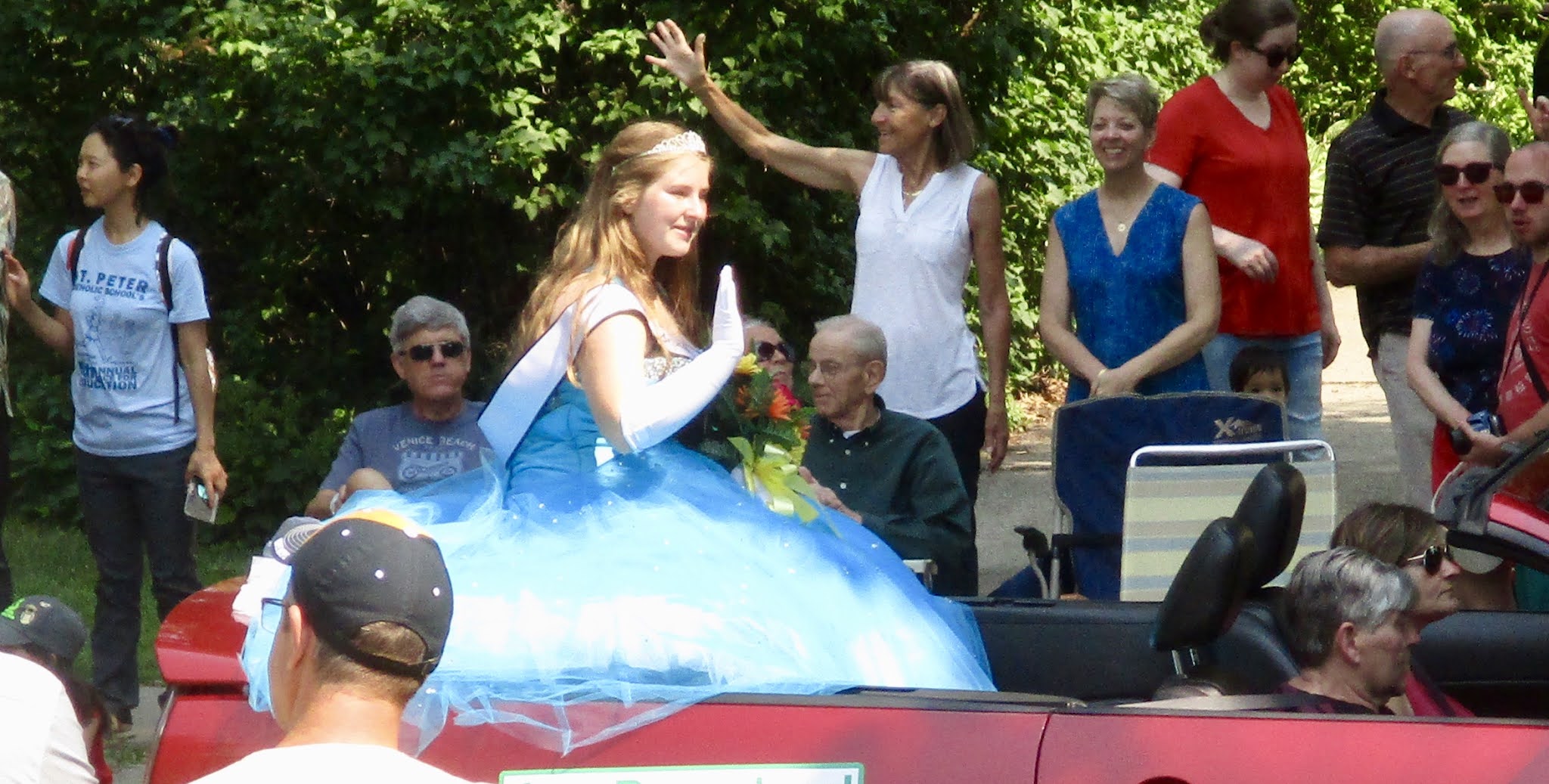
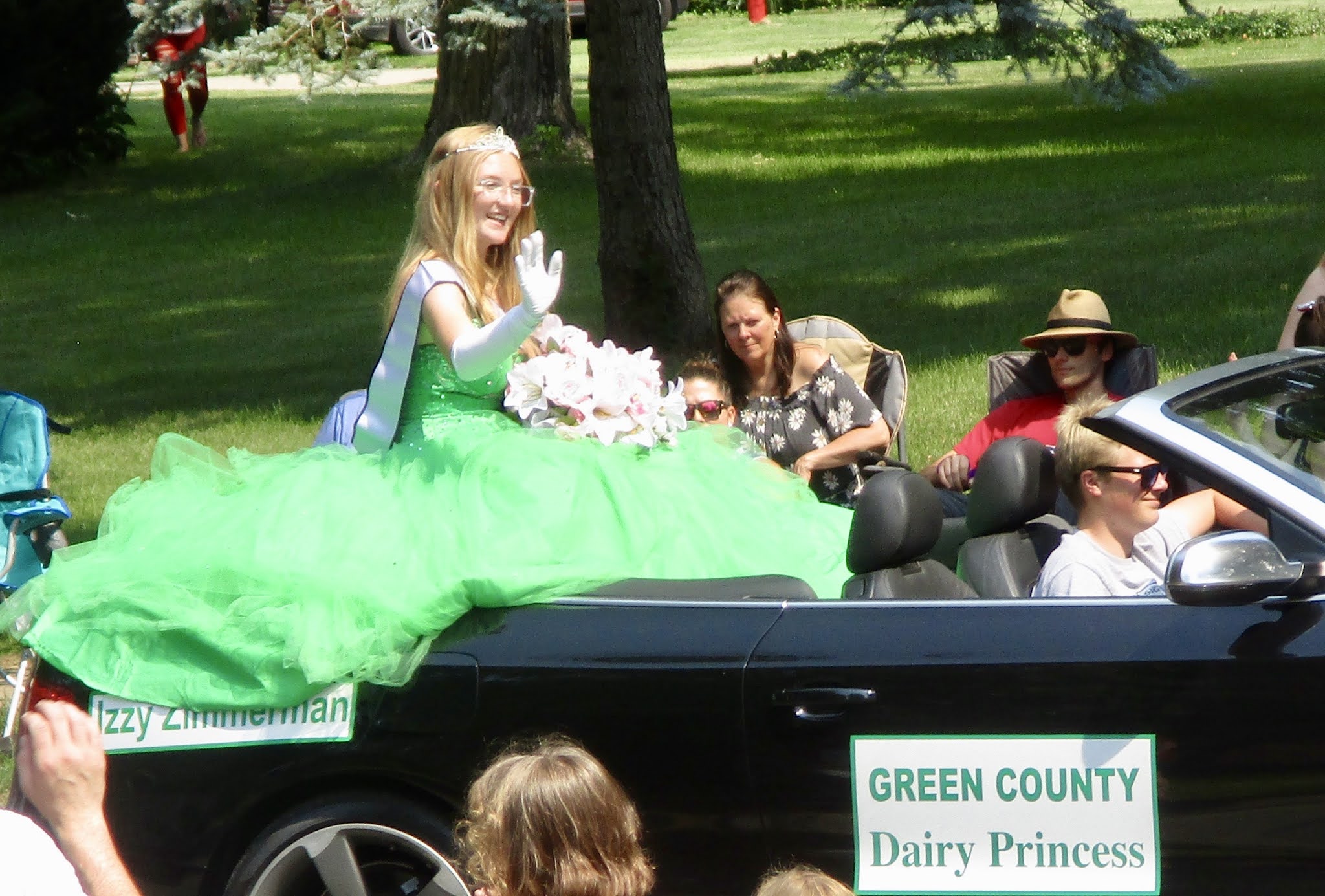
We also have our parade queens.  The photos below show just two of the many dairy queens, dairy princesses, and 4H queens who rode down Main Street.  


In addition to learning how to do "the wave" while riding in the back of a convertible, these young women are avid agriculturalists, Future Farmers of America leaders, and heavily involved in promoting the dairy industry and family farming in general.  Instead of a photo shoot wearing a skimpy swimsuit, these lovely young women pose with their calves, sheep, or horses.   Each is chosen by her county to represent farmers in her area.  There is even an Alice In Dairyland chosen for the entire state.  Dairy is a big thing here. Personally, I want to know more about those incredible gowns!
        
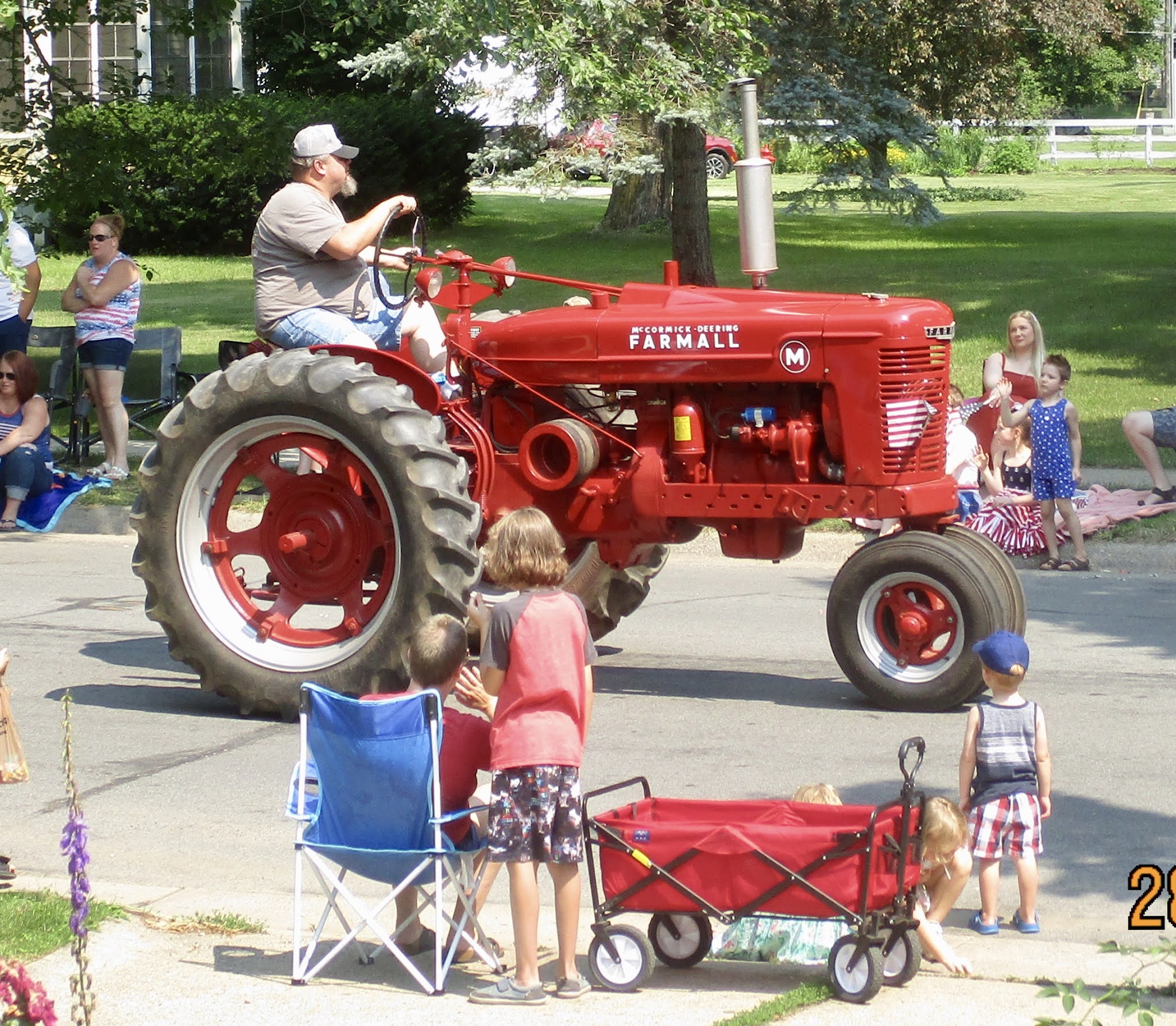
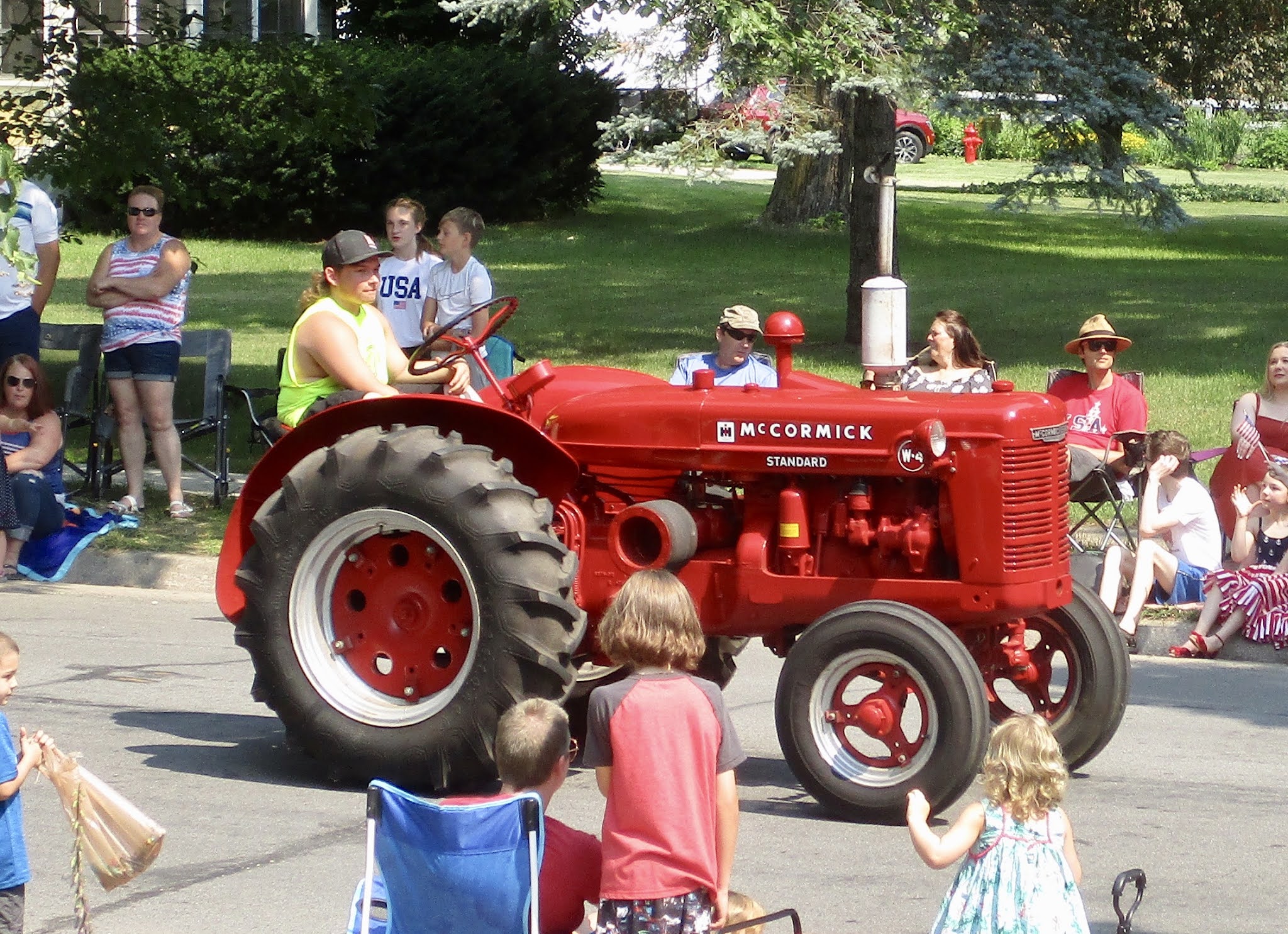
    Our parade has tractors.  Many, many tractors.  Vintage tractors are lovingly restored in these parts.  You'll notice that there isn't so much as a hint of mud or soil on those tires.  When going on parade, they tend to group themselves by their make, like Hogwarts houses.  


A  B.F. Avery tractor.  Note the hand crank in front to start it.
                                                                                                          An Allis Chalmers tractor


A Farmall tractor.  I particularly like the little boy at the bottom right who is absolutely enraptured with it.
                                                                  A McCormick Standard tractor

The much beloved John Deere tractor.  John Deere tractors are green and yellow precisely because other tractors weren't.  An old John Deer ad said it was "as familiar as the green of cornstalks and the gold of ripened grain."  I didn't know this, but the color of a tractor is called its "livery."  As a neo-Victorian, I find that charming.  


    In prior years, the littlest tractors of any given make (about the size of a riding lawnmower) would lead a line with each tractor larger than the one before it until, in some instances, the final piece of farm machinery would take up both sides of the street and kiss the branches of the trees along the way, sending showers of leaves into the crowd.  Then the next group would do the same for their maker.  Our compliment of agricultural monstrosities was somewhat diminished this year, but I hope for better things next July.

       We also have a few oddities in the parade as well.  According to the rider's sign, this is a 1935 John Deere "water cooled hit & miss engine ice cream maker."  The rider is a Korean War vet.  This is something you will never, ever see at the Rose Bowl Parade. 


 We have vintage cars.


And the Lion's Club had a float with, you guessed it, a lion on it.  


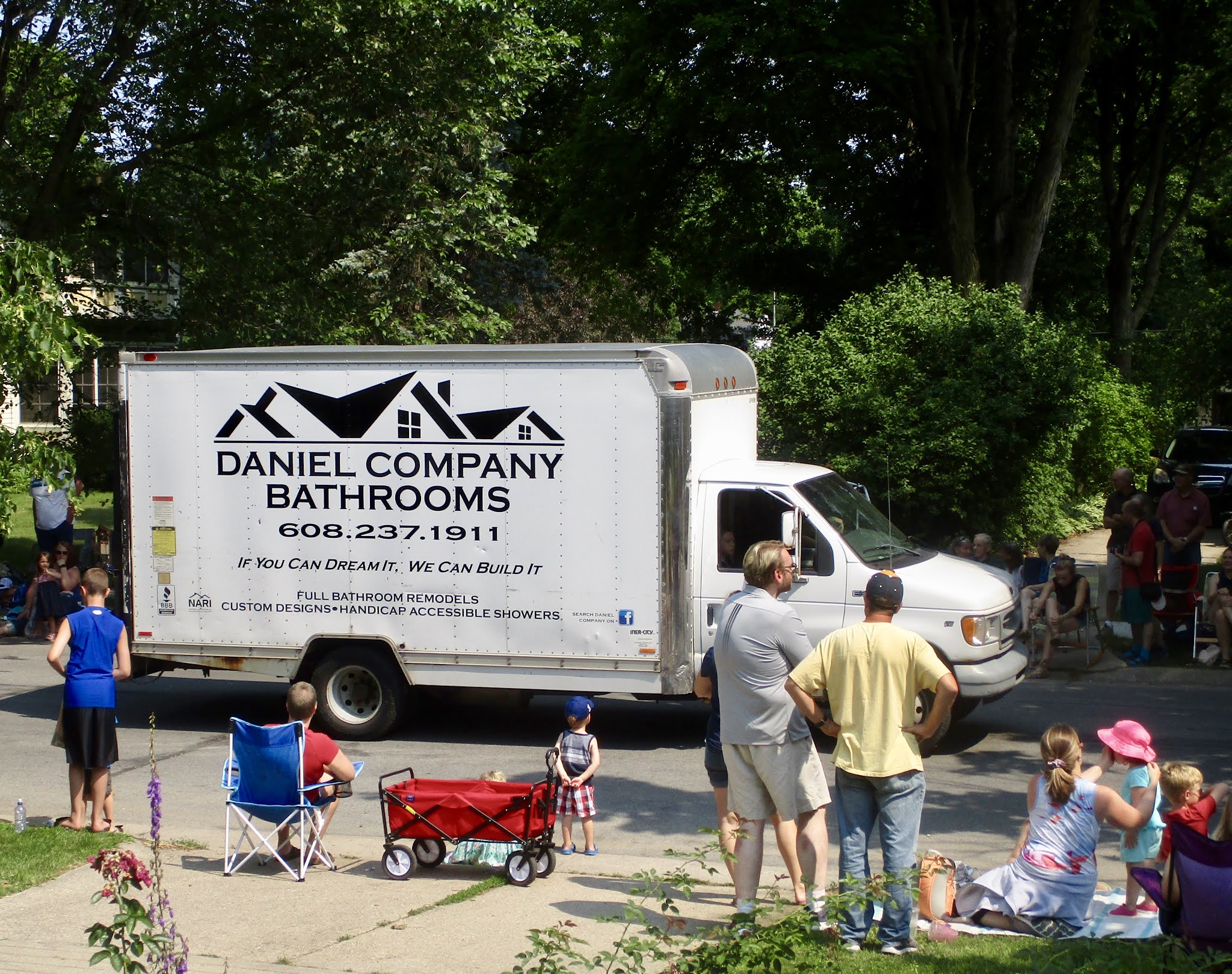
  Evansville's Fourth of July parade is unique in its ability to combine the patriotic with the practical.   As flags fly and horses clop by, the parade watchers are treated to a variety of rolling advertisements such as an asphalt truck with the company logo prominently displayed.  Or the local grain elevator sponsoring a float.  Subway will often have a dancing sandwich trotting down the street, and our local large-scale dairy always has a walking cow beside its vehicle.  And they throw yogurt pops.  There were two striking examples, however, that must be shared:
                                        This took me by surprise, but then there was this:


    Why, yes, that is a full-sized bathtub with shower (and shower curtain rod even) decorated with flags being pulled down the street.  What else could one wish for?

    And after a long parade, the last to come are the fair lads of the Evansville Jays, our hometown baseball team.  They play a game on July 4th every year at Lake Leota Park.  I'm not a sports fan by any means (it's nearly heresy to say that in Wisconsin), but it's great to live in a town with its very own baseball team.    

    And all of this rolls right past my front porch where I can sit and have tea and watch the parade pass by.


*My apologies in getting this post up late.  The process of sorting through dozens of photos was a bit daunting.  Happy 4th of July, everyone!


Thursday, June 10, 2021

 Moving Day!  Little Pullets, Say Hello to the Big Girls!


    The cute little fuzzballs who fit amply into a 14-inch square cardboard box in the basement grew into bigger, less adorable, chicks who lived in a washing machine box in the basement for a number of weeks.  As any person who has raised chicks can tell you, there is a certain point at which the dust and mess created by growing chicks is almost more than one can bear until the weather warms up enough for them to go outside. About three weeks ago, it was finally time to begin their move toward the great outdoors, and they were transferred out of the basement to the garage and into a large, collapsible dog pen filled with lots of straw.  This was their home until last Saturday night.   

    During their stay in the garage, the rapidly growing chicks were able to get fresh air and some sun but were out of the wind and rain and were closed in at night, safe from predators.  I had to put the heat lamp  back on them for a couple of nights in early May when the temperature unexpectedly dipped to near freezing after giving us a lovely taste of warm weather.  Just as when they were in the basement, I sang them a good morning and good night song every day.  

          From left to right:  Barbara Streisand, Hattie McDaniel (rear), Goldie Hawn, and Shirley Chisholm in their garage pen

    The little ones were soon eating out my hand and learning to be picked up and carried around.  Some, like Shirley, have been pretty sanguine about it.  Others, like Goldie, put up a real fuss, and I've been blooded more than once.  Chicken claws are sharp.

    As the weather warmed up, I was able to move them from their pen in the garage to a makeshift playpen I put together out of leftover fencing.  I'd pop them in there for a couple of hours so they could get more sunshine and scratch around in the dirt and grass while we were gardening.  They had no idea what to do when I first put them in, but instinct took over in a matter of minutes, and they started pecking and scratching like old pros. 

    We kept them well away from the other chickens during their initial visits to the outside pen so they could get used to the idea of a big, wide world.  They had become their own tight-knit little flock, and when I would take one of them from the big pen in the garage out to the playpen or bring them back again, the remaining chicks, who were now well on their way to becoming pullets (young hens before they start laying eggs), would call piteously for their lost sister.  It wasn't a problem until Shirley was the last one left in the playpen one day after her sisters had been brought back to the garage.  As I was walking around the corner of the garage to fetch her, I heard a squawk, and there was Shirley, standing outside the playpen looking horrified.  She'd flown over the two-foot high fence and had no idea where she was or what to do.  Rather than running away, she walked right up to me and seemed relieved when I picked her up and carried her back to her sisters.  Barbara repeated this stunt a few days later, and I had to put a window screen over the top of the pen after that to prevent any more escape attempts.  Even so, picking up a struggling chicken while grappling with a window screen is a challenge to anyone's dexterity, and it's even more entertaining if there's wind blowing the screen around.

    As the little girls became accustomed to being outside for play time, I gradually moved their playpen closer to the main coop.  The idea was to have the  hens see the little ones when they were let out to forage for bugs in the yard.  Initially the hens were oblivious to the peep-squawking that was coming from the nearby pen, but eventually I got it close enough that they could no longer ignore the chicks.  There was some jumping up and down and flapping of wings between Elizabeth, the Isa Brown hen, and Goldie. After some more posturing and flapping, Elizabeth gave Goldie one final, withering glare, and Goldie decided it was better to retreat to the other side of the playpen and pretend to hunt for something in the dirt.   I was rather proud of Goldie for sticking up for herself, even if it was from behind a fence.  Elizabeth strutted off, obviously pleased with herself for having put the little interloper in her proper place.  One does not challenge the Queen of England.

    During the last week of their stay in the garage, I created a larger, more secure pen that attached to one side of the fence on the big coop so that the little ones could be right next to the adult hens but the hens couldn't get to them.  The delights of dust bathing and hanging out under the tree peony were fully indulged.  The little ones stayed out longer, but I still brought them in well before dark so they could get a good feed before tucking themselves in for the night


After a little over three weeks in the garage, the little pullets were now about 2/3 the size  of the adult  birds, and all the information I could find suggested it was time to introduce them to the existing flock.  I'd never tried this before.  Elizabeth, Judy, and Isis had all been raised by Betty.  I had popped them under her at night when she was broody, and after one shocked glance at the arrival of chicks she didn't remember being there when she went to sleep, that was it.  She fluffed her feathers around them and mothered them as if they had been her own.

    There are various schools of thought about how to introduce new birds to an existing flock.  Some people advocate chucking the new birds in during the day and hoping for the best.  This seems to require that all the chickens in question are adults of about the same size and that there is a large amount of space for them to run about in and places to hide. I've seen a video of this, and it looks a lot like the scene in a Western movie where everyone is in the saloon drinking and playing cards, and the outlaw gang busts in.  Things do not go well.

     Another method recommends letting the new chickens out with the existing flock while everybody is out in the yard.  In theory, when the existing flock returns to the coop at night, the new birds will tag along, and everybody will be happy.  It sounds like a grand plan until you realize that if the new birds are scared off by the older ones, they won't go anywhere near the coop and will find a bush to sleep under rather than risk the displeasure of the current flock members. This  is an open invitation to dinner with a fox.  Rounding up the strays would take more than a couple of people as well.  Chicken herding is always interesting.  

    Then there's the stealth approach:  wait until the existing flock is asleep, then quietly put the new birds in the coop.  In the morning, nobody should be the wiser.  Chickens may not be the brightest of creatures, but even they know who belongs in the coop and who doesn't.  A strange bird cuddling up to one of them is just not on.  

    I finally settled on getting the birds used to seeing each other, as I had been doing, and then trying a stealth approach to seal the deal, as it were.

    The three oldest birds - Lily, Selena, and Betty - had found a good home with a woman who rescues chickens.  Her son, who must have been about 10 years old, literally plunged into the back of the run to capture Betty and Lily, but we had a chicken rodeo getting Selena who had managed to escape.  Once  caught, Selena was carried in arms to the woman's truck and plopped unceremoniously but gently onto the floorboards.  She looked quite calm, if a little nervous.  The woman assured me that her flock was so used to having new birds dropped off that they would hardly notice my old girls' arrival.

    I waited about four days after the older girls had gone so that everything could settle down a bit, and then last Saturday night was Moving Day.  


    Per instructions, I waited until the three remaining birds - Judy, Isis, and Elizabeth - were asleep, and then Harvest and I each took one of the little pullets from their garage pen, put them ever so quietly into the coop, and then returned with the next two.  What we hadn't figured on was the flash from the camera.  Isis, who tends to be a roost sleeper, was startled awake and saw the incursion force arriving.  She was not best pleased.  

                                                 
Isis doing her best impersonation of an affronted vulture

    I had hoped that the little girls would find a place inside the coop to settle down, but Goldie headed straight down the ramp into the run as fast as she could go, and the rest of her sisters followed.   They've been sleeping at the back of the run under the coop since then.  It's safe there, and they can bunch up for comfort and security, but I hope they'll make their way up to the coop soon.   

    Things have been rather tense for all concerned, including me, while the flock is integrating.  I had thought Elizabeth would be the one to put the youngsters in their place in the pecking order, but she appears to have delegated those duties to Judy.  Mild-mannered Judy has turned into a feathered dominatrix.  I've decided it's best to let the adults out into the yard about three times a day in order to give the little ones a breather.  For the first two days, that was pretty much the only time they would venture out for food and water, and it's been too warm this week to take any chances on dehydration.  

    In the last two days, though, things seem to be settling down a bit.  Judy seems to be tiring of her role as Enforcer In Chief, though I imagine it will be some time before any of the young ones will be willing to challenge her authority.  They still stand around like girls at their first high school dance, all huddled together and ducking under one another in an attempt to be invisible to She Who Must Be Obeyed.  Goldie has been walking up the ramp to peek into the coop when the adult hens are out in the yard and the youngsters are left in the run alone.  She's quite the brave little explorer.   Things are looking even better tonight as both Goldie and Barbara climbed up to the top of the ramp and were trying to roost just outside the coop entrance.  Shirley and Hattie haven't been quite as adventurous, but they'll get there.  Because  two of Hattie's toes are a bit deformed, I'm going to have to add some additional crosspieces to the ramp so she can get up it more easily.  I've now seen both groups in the same general area of the run, and the little girls seem to be allowed to get food and water now without harassment.  I've had to shout at Judy a few times to leave the little girls alone and to my surprise, she actually appeared to listen and stopped what she was doing.  Maybe it was just a coincidence.

    I haven't been able to pick up the little girls since they were put into the coop - they're just too tense - but they do come to the edge of the run to see me, so that's a hopeful sign.  I'm sad that I can't hand feed them easily during this period.  They make a rush for the door every time I have to open it.  I'm going to wait until the two groups are well mingled before I let all of them out into the yard.  I don't want any runaway chickens.  I'm sure someone in town already calls me a crazy chicken lady, but chasing a chicken down the sidewalk might cause a bit of a stir.  

    I'm looking forward to a day later this summer when I can sit in a lawn chair next to the garden with a glass of iced tea and have one or two of the young ones poking around nearby.  And some time in September they will fulfill their primary destiny and start laying eggs, and the reason we have gone through all this faff and bother will be evident to anyone who eats one.  Incomparable deliciousness.


Sunday, May 16, 2021

Babies on Board - Chicks!

    I am a chicken lady.  I'll admit that I go all squishy when I see a chicken.  Not just a chick, a full grown chicken.  Chickens make me happy.  It's hard to be depressed when you watch a flock of chickens doing their thing.  A friend of mine called them Captains of Industry.  They get up in the morning and they are busy doing something until the sun sets.   I'm not entirely sure what they're doing, but they do it with gusto.

Betty Boop - my Buff Orpington - looks like this.

    I've had chickens on and off for years.  When we moved to Wisconsin, I was distressed to find that our City Council had recently banned home chicken keeping citing a fear of roving packs of feral chickens roaming the streets and causing havoc.  I do not exaggerate.  They even brought in a vet to scare everybody with the threat of an avian flu epidemic caused by backyard chickens.   It was a sad state of affairs for us since the people who had bought our house in California were delighted to keep the chickens we had there.  

    I was chicken-less for quite a number of years until a group of us hippie-type, tree-hugging, chicken lovers banded together to petition the City Council yet again to permit backyard chicken keeping.  I think we succeeded only because all the nearby towns and cities, including Madison, allowed chickens.  We were surrounded by happy chicken communities, and our town was the lone exception.  Nobody likes to be the odd man (er, bird) out, so the City Council relented at last.  For the record, a number of the group members tried for bees as well, but that was a complete non-starter.

    I've had two flocks that were all the same breed, but all of my other flocks have been a variety of breeds.    They're more colorful, and since they all look different, I can give them names.  Sometimes, however, these names have had to change.  We aren't allowed to have roosters in our town, so all of the chicks I have purchased were supposed to be female, but there were a number of slip ups: 


The chick who was supposed to be a hen called Jane Bennett turned out to be a rooster and had to be renamed James Taylor.  Aretha Franklin became Arthur Hull.  Stevie Nicks became Stevie Wonder.  You get the idea.  All of these boys were complete gentlemen and found loving homes where they could oversee a harem of hens of their very own.

And there was Marilyn Monroe.  Note to self: never name a chicken after a dead movie star.  She didn't make it beyond the first few days.


My original flock is now four years old, and three of the six girls from that flock are still with me:  


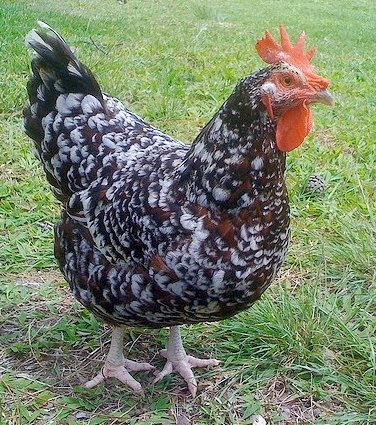
Betty Boop, the Buff Orpington


Selena Fox, the Barnevelder


                                                            and 
Lilly Daltrey, the Speckled Sussex

   As middle-aged ladies do, these girls are now in various stages of "eggo-pause".  Betty still lays about two to three eggs a week in spring, but she will taper off to nothing by fall.  Selena lays about one or two eggs a week, and Lilly is now laying mini-eggs about half the size of a regular egg when she lays at all. The last one I saw was about three weeks ago.  

    If we had more room and no limit on the number of chickens we could keep, these old girls would be with us until the end of their lives, laying or not, but we keep them for their eggs, so soon these girls must find forever homes where they can live out their golden years pecking and scratching and laying the occasional egg.  I won't give them to someone who intends to put them into a pot.  A four year old hen is  basically inedible anyway, and there are plenty of chicken people who are even crazier than I am and will shower them with love and dried mealworms.

After the old girls find new homes, I will still have three chickens left, all two-year olds:  Elizabeth Tudor, Isis Coble, and Judy Blue Eyes, and they've got at least two to three more egg-laying years yet, so it's time to get new chicks to add to the flock members who will remain.  

    Remembering my luck with girls who turned out to be fellas, and the possibility of losing one of the chicks in the first week, I decided to get four of them:  a Black Australorp, a Black Star,  a Golden Comet, and a Barred Rock.  

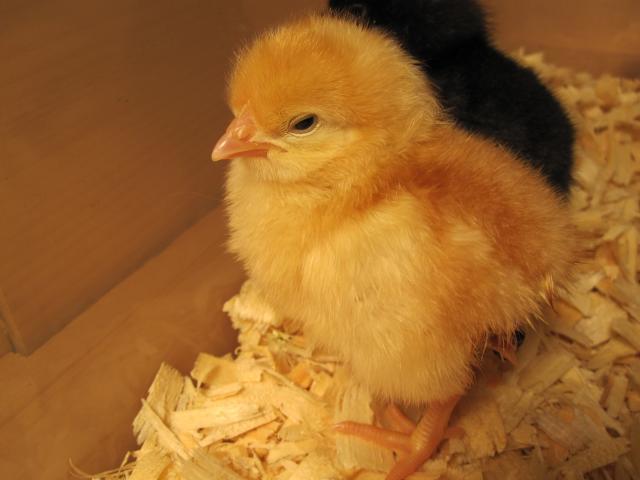
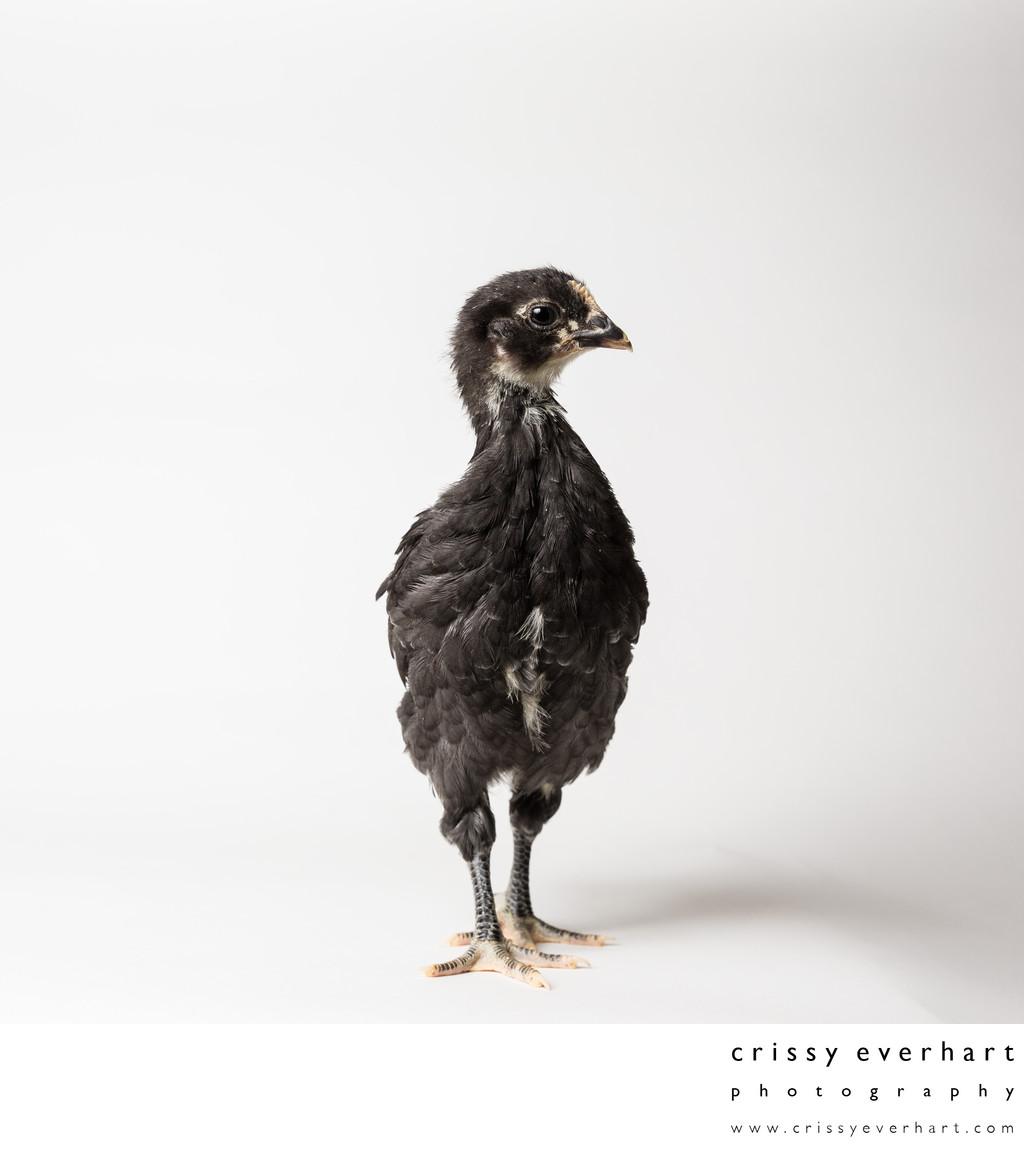
    This is what each of the little darlings looked like for about the first week:

Golden Comet - Goldie Hawn


Black Australorp - Hattie McDaniel      

                                                 Barred Rock - Barbara Streisand

Black Star - Shirley Chisholm


These little fuzzballs are the reason that people love chicks, and they look this adorable for about a week.  Then a rather remarkable, and somewhat horrific, change begins.  Let me inform you from experience, dear reader, that there are few things homelier on the planet than a four week old chicken.


     They look like one perpetual bad-hair day, and they are grumpy and sulky and sad.  They've lost 
all their cute fuzz and are in the process of having all those poky feathers sprouting all over their body - something that would probably make anybody grumpy.  If there was ever any doubt about the evolution of chickens from dinosaurs, a four-week old chicken will assure almost anyone that velociraptors once roamed the earth and are now living in your neighbor's backyard.

    This particular group of youngsters was hatched on March 19th, and until two weeks ago, they have spent most of their time in a nice, warm dishwasher carton in the basement.  I sing them a wake up song every morning and a goodnight song every night.  Two weeks ago they were transferred to a large pen in the garage where they can get outdoor air when the doors are open, but they are still sheltered from the rain, cold, and wind and no predators can get at them.  


This is what Hattie looks like now. 

Shirley looks like this.


                                                                                                   Barbara looks like this.
And Goldie looks like this.


    They're not quite the beautiful hens they will be, but they look considerably more like chickens than dinosaurs.  They each have their own personality.  Barbara is particularly bossy, and only Shirley is willing to stand up to her. Hattie tends to be the peacemaker or the "nothing to see here" chick, and poor Goldie appears to be the low bird in the pecking order, but she takes advantage of that by being at the bottom of the pile when they sleep together which means she stays nice and warm.  

    And they have discovered that humans have treats which allows me to handle them a lot more than I was able to before.  They are getting a bit cheeky these days, though, and they'll peck at my sleeves if I don't have anything for them.   On the other hand, all of this interest has worked to my advantage recently as we have now created a playpen of sorts in the backyard so they can peck and scratch around in the grass under supervision (they seem particularly taken with eating apple blossoms).  We've taken them out twice this weekend, transporting them one chick at a time from their pen in the garage to the playpen outdoors and back to the garage pen some time later.  On both occasions, the remaining chick in the playpen has flown over the fence and found herself standing alone in the yard with none of her sisters in sight, wailing for someone to come help her.  When I arrive moments later, the orphan will walk right up to me and make no protest at all as I carry her back to the safety of her pen with the other chicks.  

    Since they're only about half the size of the adult birds in the coop, they're going to be enjoying the hospitality of the garage pen for another month or thereabouts before they're large enough to begin the process of moving in with the adult chickens who will remain: Elizabeth Turdor, Isis Coble, and Judy Blue-Eyes.  That is going to be a new adventure and a new post since it's quite the process to introduce the new kids on the block to the old gentry.  I've warned Barbara Streisand already that if she thinks she's going to win in a contest with Elizabeth Tudor, she should just surrender to the inevitable now.  Nobody ever picked a fight with Queen Elizabeth I and won.  We shall see.


August - Peaches, Tomatoes, and Flax - Oh, my!     August this year seemed like a month suspended in time followed by an insane rush.  After...