Friday, September 3, 2021

Flax to Linen the Low Technology Way

    It's been a busy time during the last month as high summer is drawing to a close.  Scott Johnson of the Low Technology Institute https://lowtechinstitute.org and I took some time away from working, building, and gardening to teach a three-part workshop on growing, processing, and spinning flax.  

    First, just a touch of history (I promise).  Flax is a plant fiber, unlike wool, and requires cultivation to produce useable fiber.  Flax has been used since ancient times to create beautiful, hand spun, handwoven linen fabrics that would seem almost impossible to recreate today.  Flax was, literally, worth its weight in gold in Egypt.  Linen mummy wrappings were made from flax, and, of course, the pharaohs wanted only the very best for their trip to the afterlife.  Those very revealing garments worn by women in the tomb paintings of those pharaohs - very fine, very sheer linen.   

    Flax was also grown throughout Europe and is known to have been used to produce cloth at least 3,000 years ago in England - way, way, way before the spinning wheel was even imagined.  And flax has crept into our English lexicon in all kinds of sneaky ways, as you will soon discover.

    Before cotton was available, linen was used for everything from sheets and towels to underclothing. And in case you're wondering: no, people didn't wear the same clothes every day all year round for years on end.  They may have only had one or two outer garments at a time, usually made from wool, but they changed their linens (their underwear made from linen) quite frequently to keep themselves as clean as possible.  You might only have two sets of outer clothes, but you had a bunch of linen unmentionables.   If you wonder why we have "linen sales" today, it's because sheets and pillowcases were also made of linen back then.  Unlike cotton, linen lasts.  It was common for linen items to be listed in a will.  Many people have been given their grandmother's linen tablecloths and napkins, and they never seem to wear out.

    There's a reason that fine linen fabrics are so expensive, though.  The process of converting flax plants into linen yarn to be woven into fabric is time-consuming and labor intensive in the extreme.  It takes a ridiculously long time to do it - so much so that one has to wonder who came up with the idea in the first place and why.  However, in a world where fossil fuels were minimal, such as the Victorian era,  flax and wool would have been two fibers that could be grown, harvested, and processed our local area.

x


    Not just any old flax seed will work for fiber.  If you imagine that you're going to be able to go to the local co-op, scoop up a pound or two of seed, plant it, and have fiber to spin, you will be sorely disappointed.  There are two kinds of flax: the type for seeds and the type for fiber.  Almost all of the flax grown nowadays is the type for seeds only, and the plants are completely unusable for fiber.  The varieties that produce fiber are hard to come by and are often imported.  

    Scott has been growing a small plot of flax for about three years now, and the first half of our workshop series centered around growing and processing flax. On the first day of the workshop Scott took the participants through the planting and growing process, including instructions from The Book of the Farm published in 1842 by Henry Stephens. Spanning three volumes, 91 chapters, and 1384 pages, it was the farming bible of its day.

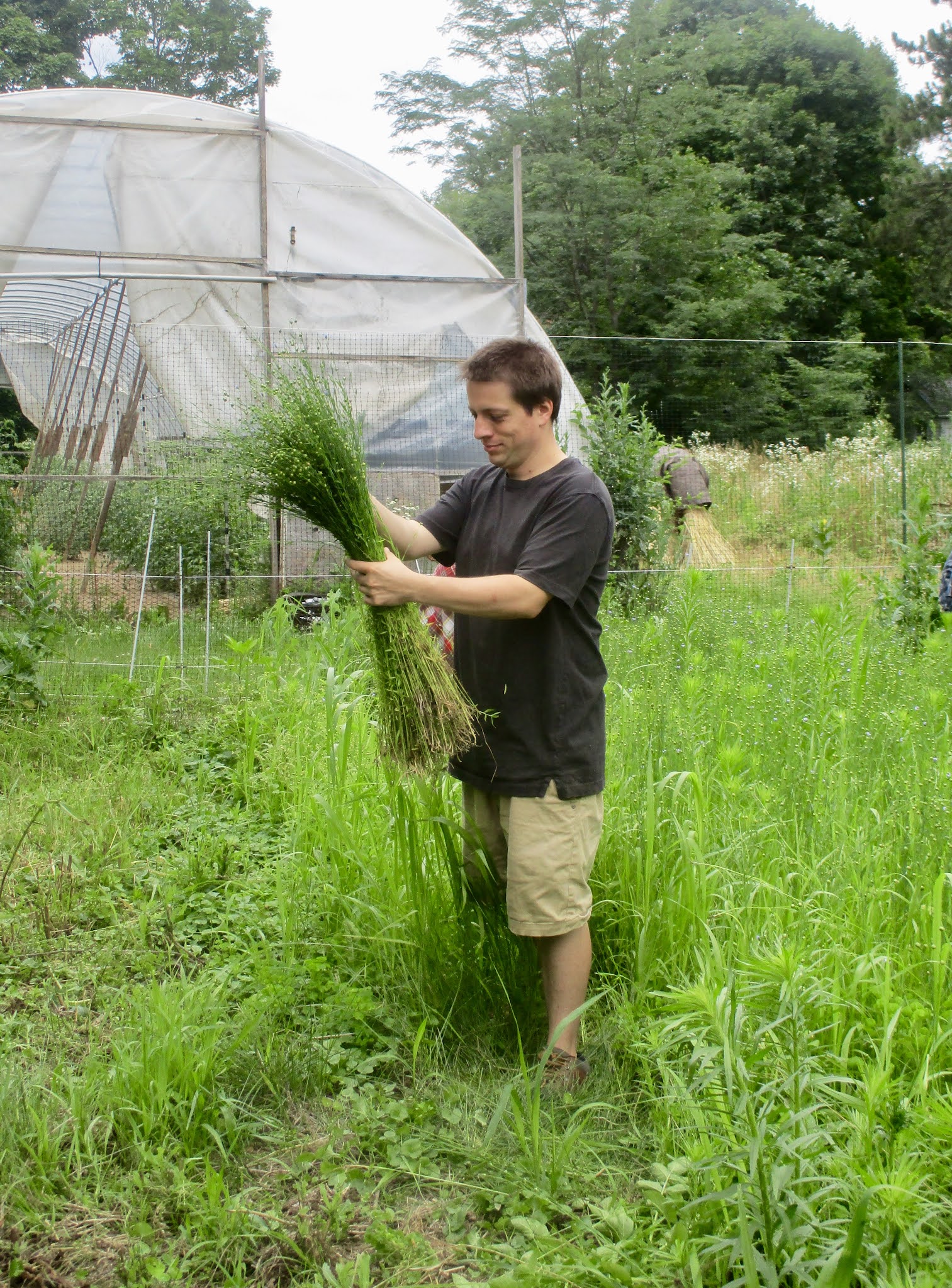
                                                              Toni harvesting flax                                           

    After learning the basics of planting and growing, everyone trooped off to the flax field to harvest the flax.  We spent a good while pulling the long, thin stalks out of the soil by hand.  Flax is harvested by pulling up the plants rather than cutting them down.  Thankfully that's easy to do on Scott's small plot, but it would be back breaking labor in a large field under a summer sun.


    The plants are then tied into bundles with more flax and laid out to dry in the sun.  I have to admit that my bundle tying skill was seriously wanting.  The bundles held together - barely.  I'm a good spinner but a lousy bundler.


Brian bundling flax like a pro.


                                                                                                                        Flax bundles along the fence line

                                                                The flax harvesting crew


Scott teaching his son, Felix, about the mysteries of flax.  Felix was quite interested in it.    


    After the flax dries out a bit, it's time to  ripple and ret it.  Rippling is done by passing the tops of the flax stalks through a giant comb which pops the seeds off the plants so they can be saved for next year's crop.  With the scarcity and expense of those European seeds, every seed saved from Scott's flax crop counts toward a larger plot each year.  

    Retting is just a fancy word for rotting.  If you have a nice, dewy lawn and about five weeks to spare, you can spread your flax out, flip it over every couple of days, and have lovely, silvery, "dew retted" flax.  The faster, but smellier, way is to submerge it in water for about 10 days until the outer part of the stalk begins to rot away  You know the smell of a lake in the middle of summer when the water level goes down and the lake weed starts to rot?  That's the smell.  It's fairly awful.  Scott retted a crop in his canoe, and I wonder if the smell ever came out.  It tends to linger.  (Correction:  Scott says this only takes five days in his experience.  He did not, however, minimize the extent of the smell.) 

    After retting, the flax is allowed to dry out again, which takes most of the evil smell away, and then it's time break it.  This sounds like some form of medieval torture, and if you look at a flax break, you might be inclined to agree.

                                                                    My antique flax break
    
    The useable fiber in a flax plant is inside the stalk, and breaking the stalks begins to release the outer layer and expose the fibers inside.  The idea is to hold a fist-sized bundle of stalks in one hand and then bash the heck out of it between the jaws of the break.  It's a lot like chopping cabbage with a wooden cleaver now that I think about it. If you're doing this on a windy day, keep the wind at your back.  The chaff flies absolutely everywhere and will happily embed itself in your clothes, your hair, and your socks.   


Ani hammering away with the flax break.


    The next step is scutching.  Scutching comes from the Old English or Scottish word scutch meaning "to beat or whip".  Sounds lovely, doesn't it?  The piece of wood that is being used is called a "scutching sword".  Oh, dear...


Flax hackles

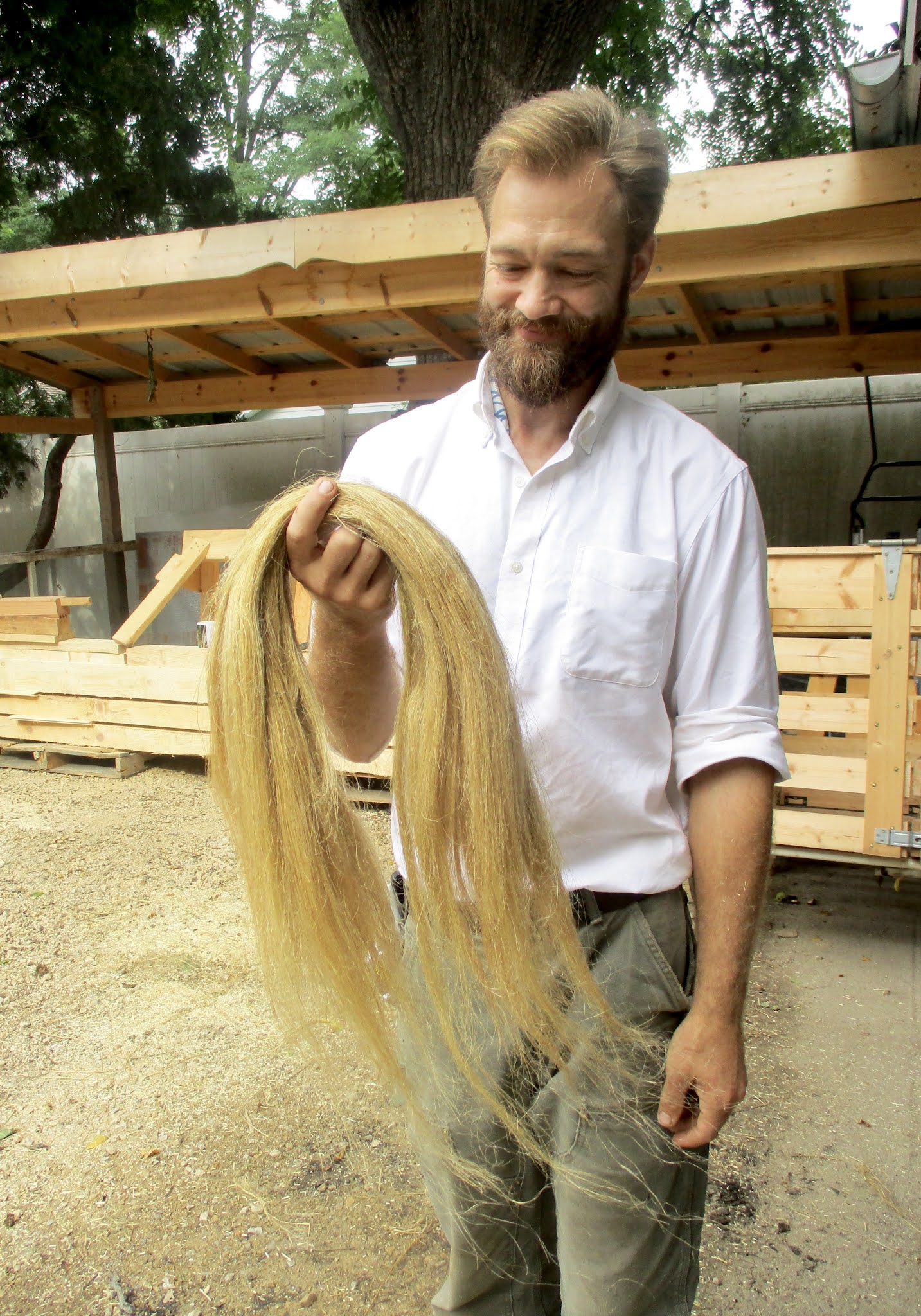
    This vicious-looking contraption is a flax hackle, the ultimate in fiber torture devices.  In order to remove the last of the chaff and obtain a fine, smooth, spinnable fiber,  the hanks of flax are run through the nails.  The larger, more widely spaced nails are used for the first few passes, then the middle set, which  is more closely spaced, and then the finest set.  As each bed of nails receives the flax, it becomes finer and finer, eventually resulting in something that looks like blonde hair - "flaxen-haired" - and is ready to spin (almost).  

    Hackling leaves behind coarser and shorter strands of fiber called tow which can be spun into twine or even rope.  A "tow rope" didn't just tow things: it was made of tow  Scott tells me that in processing flax, only 10% of the original plant remains after the entire process is complete, so saving and using every little bit is important.  Tow is also a dandy fire starter, and Scott has caught me more than once mooning over the piles of tow he wants to use for rope and I want to use for kindling.

    Another sneaky entry into the lexicon at this point is "tow-headed", meaning blonde.


                                             Scott holding one of the beautiful hanks of hackled flax
    
    That beautifully hackled flax will happily tangle itself into impenetrable knots if left unattended, so it must be twisted into a strick in order to keep the strands in order
.   Scott takes a handful of the hackled flax he's been working on, goes twisty-twisty, and, hey, presto! a perfect strick lies in his hand.  You would think, being a master spinner, this would be a piece of cake for me.  Nope. I take my handful, set my tongue just so and whine and grumble and curse the day I ever laid eyes on this stuff, and eventually I am rewarded with a less than perfect, but still serviceable, strick. By the way, strick appears in English  about 1400 A.D. and is  apparently the root form of "strike".  More torture.  Poor flax. 

    And after all the growing and harvesting and drying and rippling and retting and more drying and breaking and scutching and hackling and twisting into stricks, it is, at long last, ready to spin.   If you are a wool spinner (feeding, shearing, carding, spinning), you are likely to be exhausted just reading this.
    
    Spinning is my specialty, so this is where my skills enter the picture.  First you need a distaff.  


    A distaff is a stick of some kind that you tie your flax onto.  It can be attached to your wheel like so:


    Or it can be s stick that sits on the ground like this one or is held in the crook of the arm, which makes it portable.  Many distaffs are simple, but other ones are highly decorative with elaborate carving and painting including one with a beautifully carved image of St. George slaying the dragon.  I do not lie.   


    Since women did most of the spinning, and used distaffs, yet another term creeps stealthily into the language: the "distaff side" meaning the woman's side of the family including her female relatives.  
    Putting the flax onto a distaff is called "dressing", and I think this is the most important part of the entire process of transforming flax into linen.  This is the place where the grower, the processor, and the spinner meet and, metaphorically, shake hands.  As I spinner, I am taking the work of others into my hands to produce thread from the fiber they have spent so much time and effort to bring to my wheel.  

   The lovely little stricks are untwisted and, slowly and carefully, the fibers are fanned out, layer by thin layer, into a fan shape and then rolled onto the distaff.  

We sat in Scott's parlor and chatted about all manner of things while we fanned out our fibers.  Among other topics, I learned all about the various methods of tanning leather, including brain tanning, which is not a conversation one usually overhears at a local Starbucks.  

Fanning out the fibers
  

  Rolling the fanned fibers onto the distaff.

    And finally the drizzly day came that was the culmination of all the work that had been done - spinning!

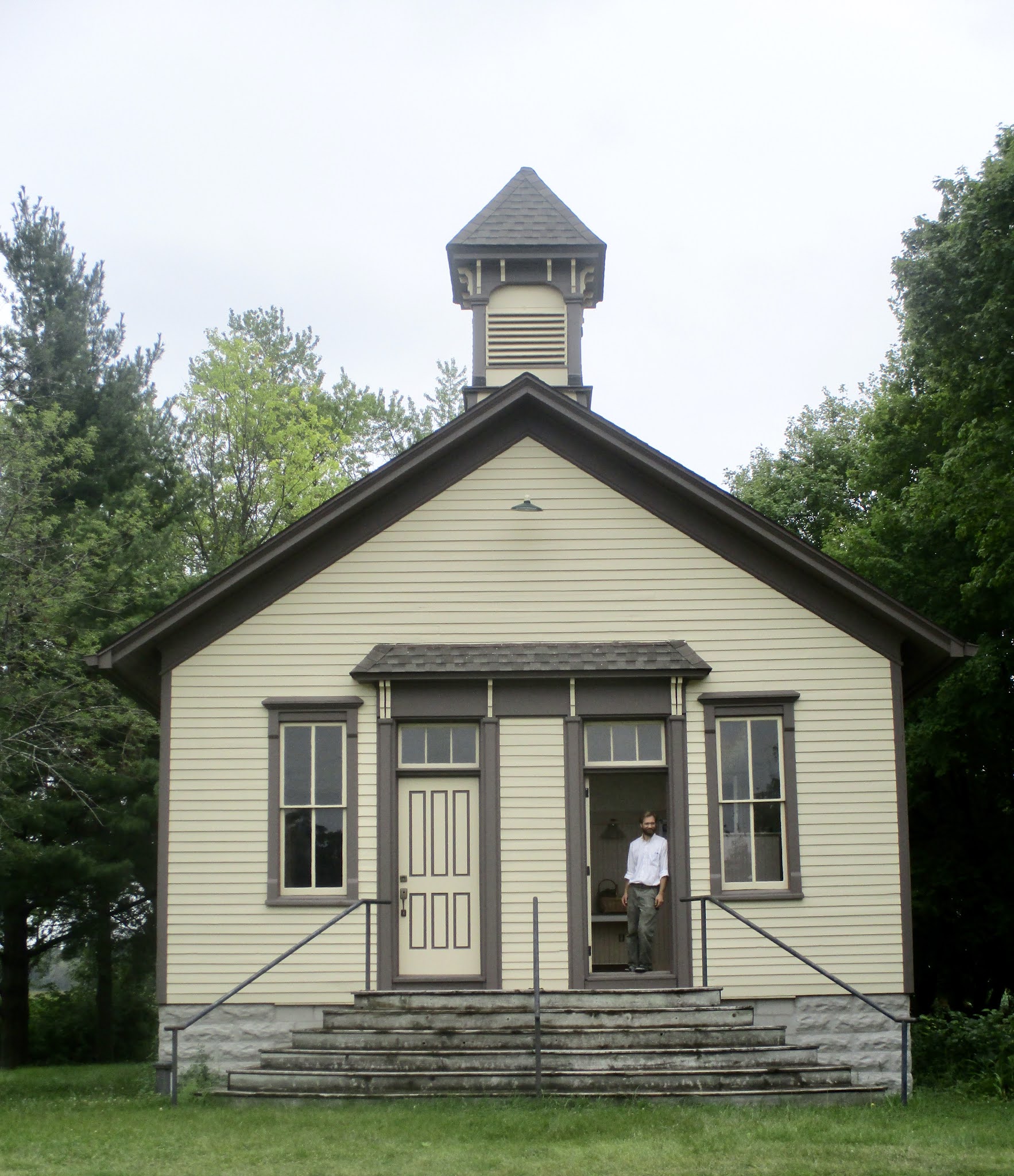
                                         The Cooksville Schoolhouse where we held the last class session


    The moment flax is twisted into thread, it is no longer flax; it is linen, and its value increases substantially.  All of the participants in this final class were experienced wool spinners, but none of them had ever spun flax.  They found it quite a challenge to change from their customary wool spinning technique to the technique required for flax, as I had also experienced when I started to spin this fiber.  It's a very different process compared to spinning wool.  Wool is very forgiving, but in spinning flax, there is little room for error.   Some of the participants soon discovered that it was a meditative process once they got the rhythm of it.   While we spun our threads, Scott sat in a corner in the back, quietly teaching himself to spin tow.  He thought nobody noticed.  I did.


     At the end of the class, we all laid our little skeins out on the floor to admire them - even Scott who had to be coaxed into showing his.  It was fascinating to see the differences in the various skeins, and every participant  showed promise in becoming a good flax spinner with practice.

    Learning a dying art brings us closer to the people of the past for whom this was a common, but vital, skill .  For me, it is one more way to experience part of what life was like for rural people in this area during the Victorian era.  When I'm at my wheel with my distaff at my side, my wheel turning steadily, and linen thread running through my hands, I feel a connection to all the women who have done this task before me and to those who keep this skill alive in the face of technology that can do it faster, but not necessarily better, than the work of human hands.  


Sunday, August 8, 2021

Lammas - First Harvest

    Lammas, also called Lughnasadh, is the first of the three harvest celebrations of the year, the other two being Autumn Equinox and Halloween.  In Middle English, the celebration was called Lammasse, meaning "loaf mass", and was a Church holiday on which the first loaves of bread from that year's grain were consecrated.  Another name for Lammas is Lughnasadh, a harvest celebration particular to Ireland, Scotland, and the Isle of Man.  In the story of this holiday, the god Lugh fights to steal the grain for humanity and avoid the blight that would ruin the harvest and starve the people.

    At our house, this holiday has gained in importance as our gardens have grown in size.  We have a small altar in the back of our property on which we have placed offerings of this year's first produce  You can see a summer squash, green garlic, and a small sheaf of wheat I harvested at the Low Technology Institute https://lowtechinstitute.org.  

    It's considered bad luck to start the harvest season with last year's grain, so I managed to grab a few wheat stalks at the Low Technology Institute when I was co-teaching a class on flax processing and spinning with Scott Johnson, the head of the Low Technology Institute.  Scott grows and mills his own wheat on a small homestead in Cooksville, Wisconsin, and he showed me a couple of his beautiful wheat sheaves.         

 The garden gate at the  Low Technology Institute     


 Lammas is a time for assessing the progress of planting and for celebrating the abundance still to come.  In the spirit of the celebration, here is a tour of the progress of our gardens and other projects we started this spring.  But before we begin, I must tell you a bit about the harvest loaf.  

    Each year, we bake a harvest loaf for Lammas.  Sometimes it's a rounded braid, sometimes it's a perfect sourdough loaf; sometimes it's in the shape of a sheaf of wheat, sometimes like a corn dolly or an abundant goddess figure.  This year Harvest did the honors by making beautiful focaccia bread decorated with tomatoes, squash blossoms, basil, and garlic scapes, all from our own garden.

                                  Share the harvest loaf with us as you take a tour.
                                                      

Thanks to well-composted chicken straw (thank you, ladies!) and Harvest's loving care, we are on the verge of a vegetable explosion.  Harvest doubled the size of the garden this spring and put tomatoes on "her" side with a few pepper plants that I was allowed to put into an unused corner. I put in quite a few non-tomato veggies on "my" side, but the squash is climbing every available surface, including fencing.   Although I have a lovely diagram telling me where everything should be, the squash has had other ideas this year, and I can't tell what's where anymore.  I brought in what I thought was a not quite ripe squash to cut up for dinner.  It was unbelievably bitter.  I couldn't figure out why until I realized  later that it must have been an unripe melon instead.  Even the best laid plans, or in this case, the best drawn diagrams, are of no use when the squash goes berserk. And yes, I know that squash has a tendency to do this, but this is becoming squashmageddon.  Somewhere underneath the squash vines, the broccoli and broccolini are hiding. I've seen glimpses of the blue-green leaves, but I can't get to them for the squash vines, and there's something in me that just can't cut back a vine that has blossoms and potential fruit on it.  Good thing the broccoli and broccolini are cool weather crops.  The squash leaves are keeping them cool, and they should be visible when the squash vines start to die back.  I hope.  


    This happy chappie is a Candy Roaster squash.  It's a great keeper, but does get large.  It's the size of a miniature poodle now, but this one promises to be the side of a toddler when it's all grown up.  I have no idea how I'm going to carry it inside much less where I'll put it.

    The peppers and sunflowers are coming along.   I had hoped to plant a Hungarian pepper variety so that I could make my own paprika, but the plants didn't make it though the indoor planting stage, and it was too late to start over, so I've settled for some Louisiana peppers that are supposed to be both hot and sweet.  I'm going to let them ripen to deep red, which should mellow them somewhat, then dry them, hoping they will give a little kick to dishes without overwhelming heat.

    Because we had cedar apple  rust on our apple threes, we decided to cut two of the three down to about  four feet in height.  When apples trees are planted too close to cedar trees, there's nothing that can be done about it except to remove the cedar trees, which, unfortunately, are on the neighbor's property.  We didn't know about it when we planted the apple trees and didn't figure it out for years.  The apple trees had to go.

    We left one tree up for shade, knowing that any apples it did manage to grow would be inedible, and we took down the other two leaving tall stumps as handy places to put tools.  We planted a charming little flower bed around the stump in Harvest's side of the garden.  As you can see, the apple trees, like the squash, have had other plans.  The trimming, vicious at it was, seems to have encouraged them.  I think this one makes a charming little topiary, and perhaps we'll get a good crop of apples from it next year.

    Meanwhile in the raised beds in the front of the house, the beans have been harvested.  


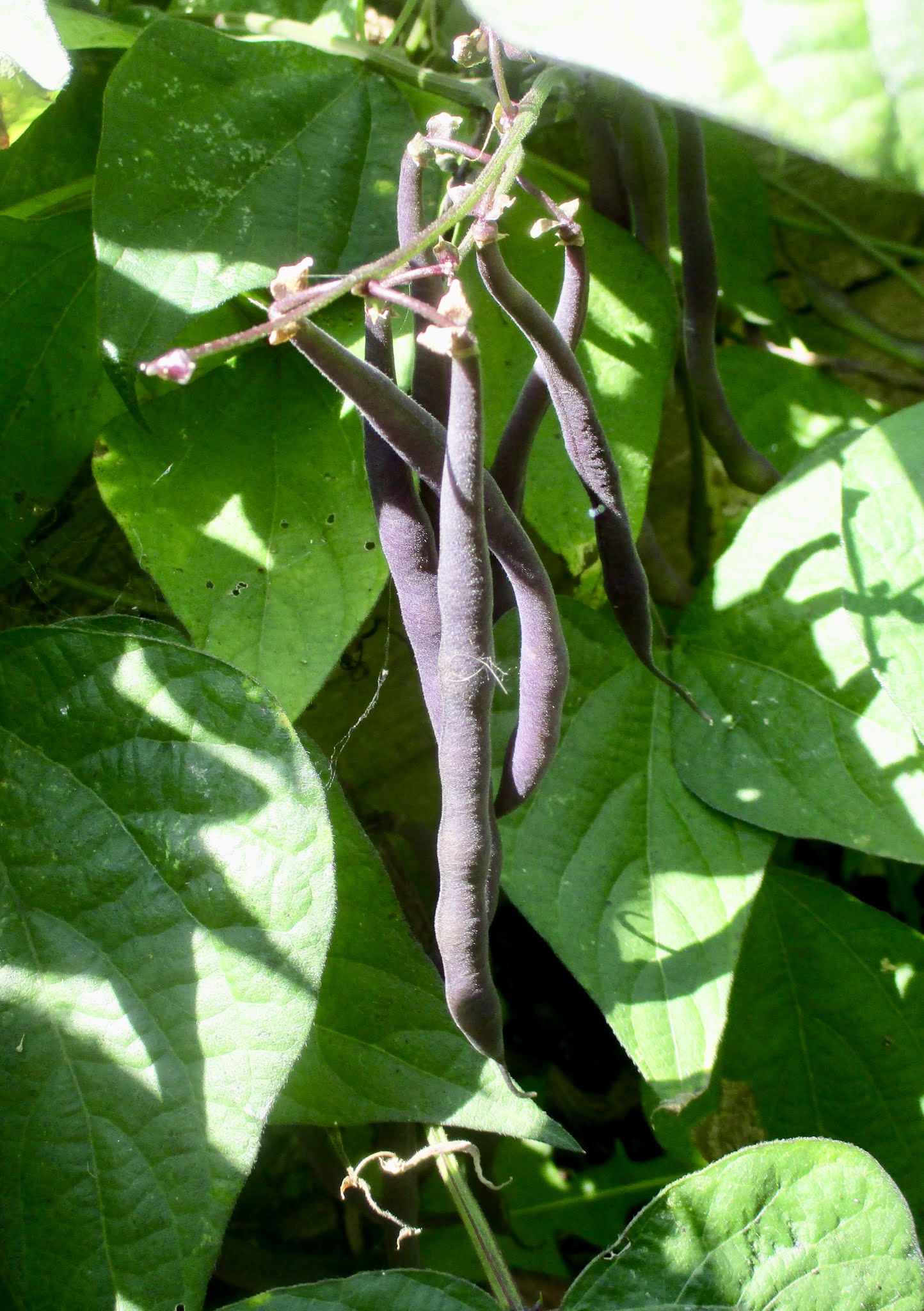
    These are purple-podded bush beans.  They're easier to harvest because they're more visible, but they're not as crunchy as we would like, and their window of harvest time is very narrow - just a few days - so we've frozen them, and Harvest has planted a second crop of the faithful Blue Lake beans.  They're coming up like troopers, and it looks like we'll have beans by late September or so.  


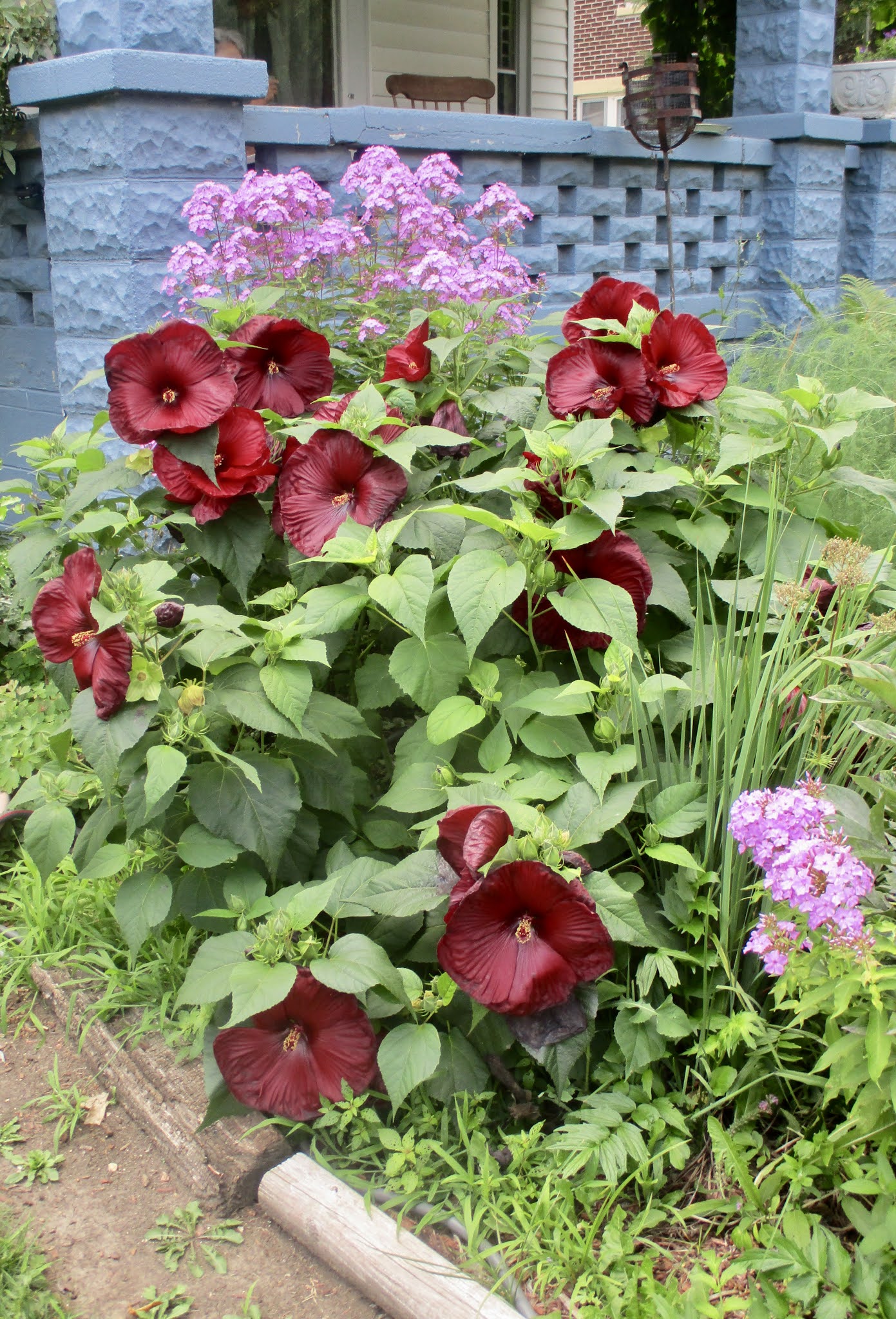
Next to the house in the front yard, the dark red hibiscus are blooming profusely.  If you look at the photo, you'll see the railing of the front porch, and you can see how huge the flowers are.  The smallest ones are the size of a luncheon plate.  The dark red flowers are perfect for dyeing wool, which is why I bought a plant.   It gets bigger every year, but who could complain with a show like this.  Because they only last a day or so, they have to be harvested and dried the moment they start to wilt.  On the other hand, they give us an ever-changing view as the flowers come and go on various parts of the plant.

Enormous hibiscus next to the porch.

    And in the chicken coop, all is well at last.  Those cute little fluffballs that turned into ungainly teenagers have finally turned into hens, and they should start laying eggs around mid-September.  We've been hoarding the eggs we do get at the moment because we only get two from the Prairie Blue Eggers, Isis and Judy, and a small one from Elizabeth who, after months of not laying a single egg, decided to come back into lay, thereby saving herself from a trip to another home.

                                            The "little" girls.  Left to right: Hattie, Shirley, Barbara, and Goldie

    Everyone sleeps in the coop now, and though each group tends to stick together, there are no more scraps, and they all spend time peaceably in the yard together.        

                Little girls to the left, big girls to the right.

Having been raised by hand, the "little girls", as I call the former chicks, entertain themselves by following me around.  This sounds like a brilliant idea until you realize that they are following you down the driveway toward the street.  And, of course, each group has their own way of getting into mischief in two separate areas of the yard, naturally, which involves shooing one group away from where they shouldn't be, then going to find the other group and what trouble they've got into.  Meanwhile the first group... you get the idea.  I had a notion at one point to sit in the yard and read with the chickens pecking around nearby.  It didn't happen.  On the other hand, Barbie and Hattie like to be petted and held, so that makes up for it a little.

    As the harvest time continues, there will doubtless be more tales to tell.  Meanwhile, I will leave you with the sound of cicadas.  The sound starts almost like a cricket and then rises to what I can only describe as a "shiver" before subsiding again.  For those of you who have never heard the sound before, it is surreal, and it means that summer is beginning to wane and autumn will be arriving before we know it. https://soundbible.com/920-Cicada.html


Friday, July 23, 2021

July 4th - I Love A Parade!*

       Who doesn't love a parade?  Whether they are living in Ancient Rome, Medieval Japan, Renaissance England, Los Angeles, or New York City, humans just love to strut their stuff, and if they can do it in groups with observers watching their every move, so much the better.  Come to think of it, can a parade really be called a parade if there's no one on the sidelines to watch it?  
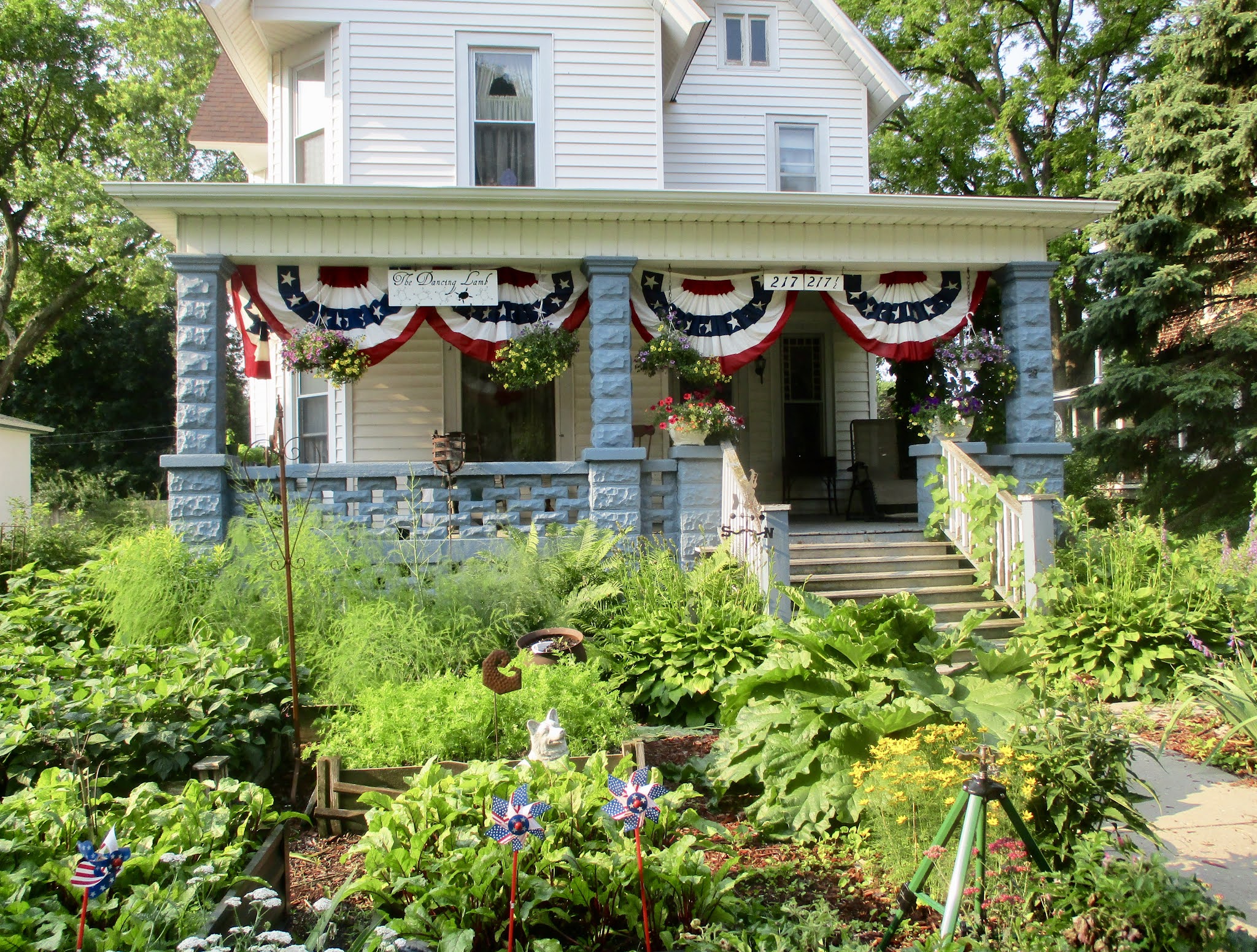
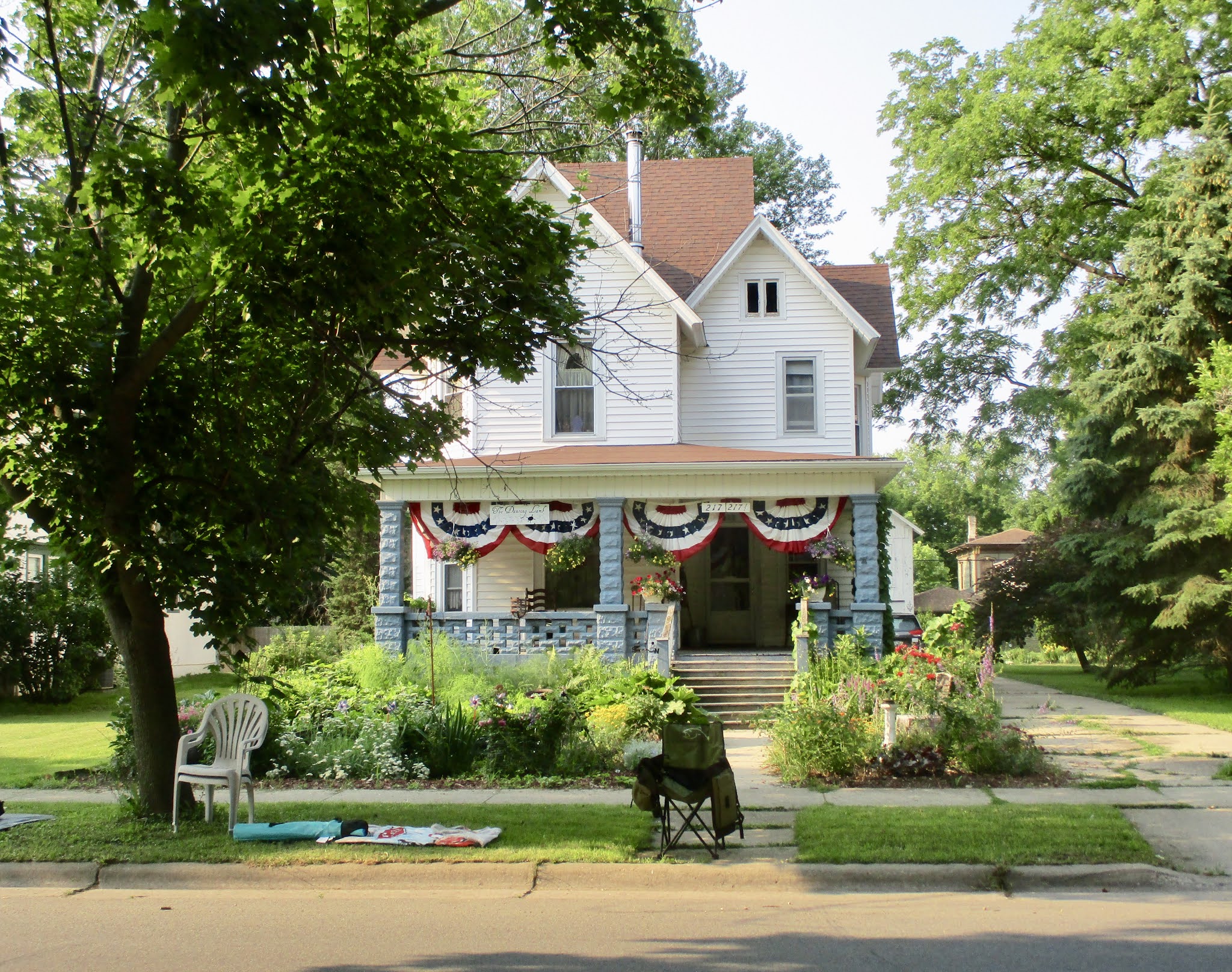
    As always, Harvest decorates the front porch with real fabric bunting, and this year she bought little stars-n-stripes pinwheels to stick into the raised beds in the front garden.  Since there had been no official parade last year due to COVID, everyone was in high spirits this year and wanted to secure their preferred spot as soon as they could.   In years past, this has involved putting a blanket or chairs down on the "terrace" of grass between the sidewalk and the street the evening before the parade.  This year, however, the claim staking (with real stakes at times) was in full swing by midmorning of the day before the parade.  

   Being the little Norman-Rockwell-meets-Mayberry-RFD-meets-Currier-&-Ives town that it is, Evansville is no slouch when it comes to parades.  Evansville is a town that is close enough to Madison, Wisconsin to be within commuting distance of the city, but it is surrounded by farmland for miles in any direction, and our parade has a distinctive small town feel to it without being artificial.  The floats are often pulled by tractors, and some of the participants include things like the local karate kids trying to look as fearsome as possible while running through their training routines as they punch and kick their way down the street.  The local dance academy has a float.  The kids' roller hockey team skates down the street in a kind of mock game which appears to be missing sticks.

    As with all proper July 4th parades, the military color guard leads the way.  We all stand respectfully as they pass.  As they go by, the oldest veterans look even older, and the Vietnam Vets have long since turned grey.  Now there are men and women marching down the street who are much younger than I am.  There are not many of these vets, probably just a little over 20 in all, but in a town this small, that's a significant number.

    Following on the heels of the veterans are the fire trucks.  This is either a way for residents to see that their taxes pay for some really cool emergency kit, or it's for the kids (usually little boys of about two) to jump up and down, pointing and saying, "Truck!  Truck!  Truck!"  Or both.  The hook and ladder engines are some of the most impressive, but ambulances, tankers, and emergency vehicles of all kinds from nearby towns roll down the street, all bright and shiny and looking like they've never been within six miles of a fire.  It's a longstanding tradition that the firefighters, paramedics, and whoever else is riding on the vehicles toss candy almost continuously to the people lining the streets to watch.

    And what would a parade be without horses?  Bo, the black Percheron who pulls the carriage for the Evansville Carriage Company (see the post "The Surrey With the Fringe on Top") was ridden by his owner, Camille Skotnicki, with two of the other horses who are in the same barn.   It's hard to get a feel for how enormous Bo really is, but Camille looks like a child riding him, and she's a full-grown woman.  He's a big, big boy.  And a very handsome fellow he was, too. 


Another riding group followed a short time later.    


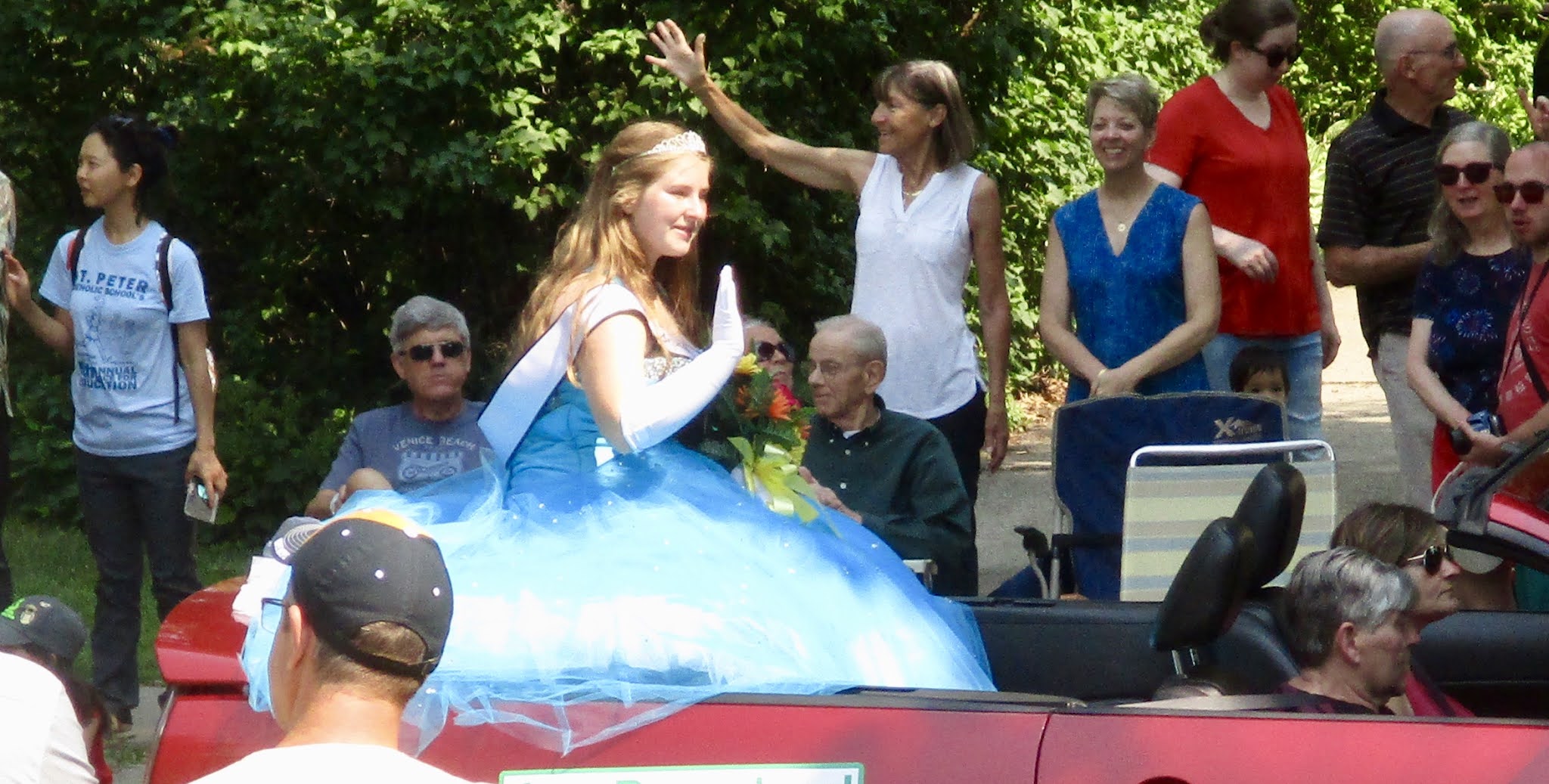
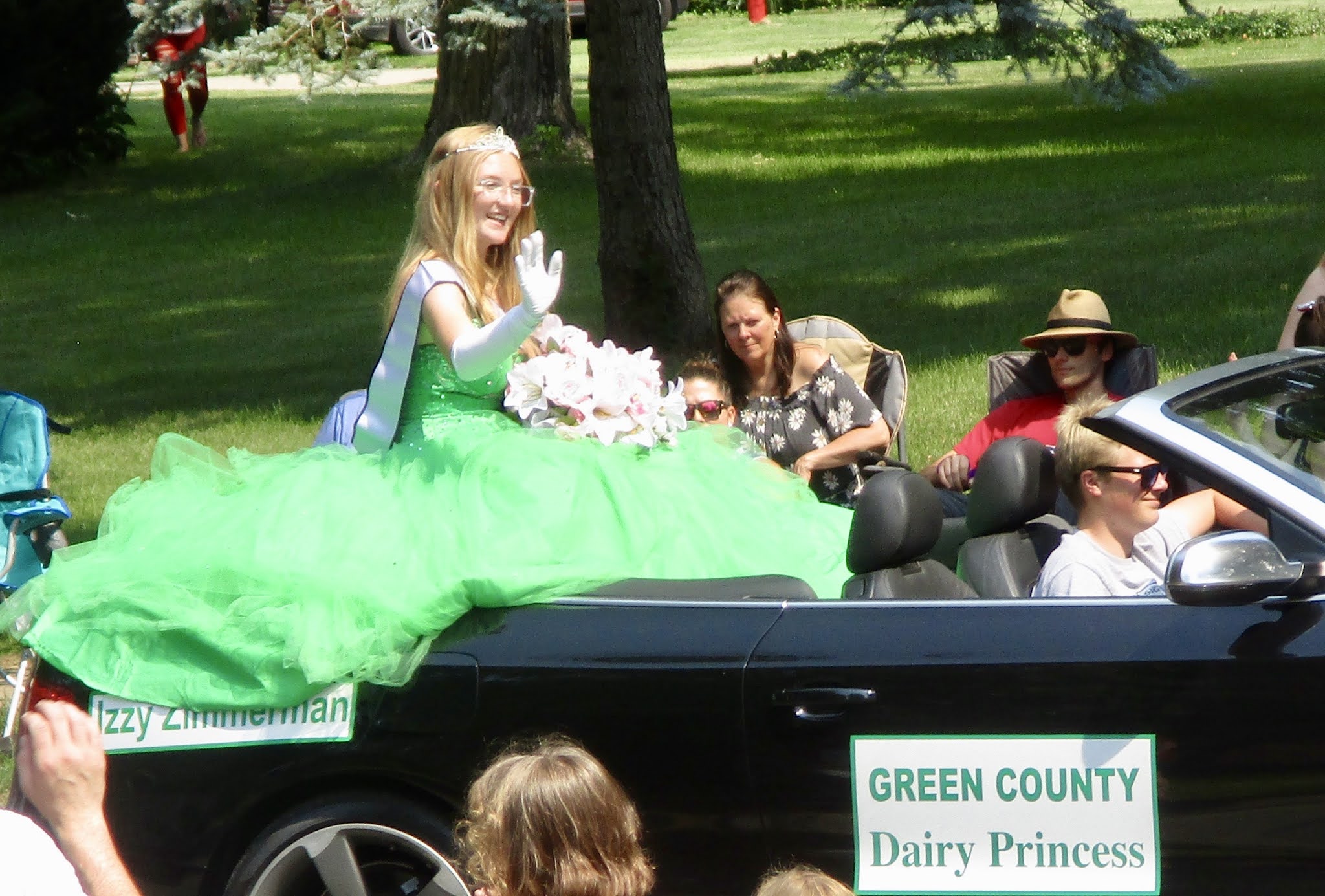
We also have our parade queens.  The photos below show just two of the many dairy queens, dairy princesses, and 4H queens who rode down Main Street.  


In addition to learning how to do "the wave" while riding in the back of a convertible, these young women are avid agriculturalists, Future Farmers of America leaders, and heavily involved in promoting the dairy industry and family farming in general.  Instead of a photo shoot wearing a skimpy swimsuit, these lovely young women pose with their calves, sheep, or horses.   Each is chosen by her county to represent farmers in her area.  There is even an Alice In Dairyland chosen for the entire state.  Dairy is a big thing here. Personally, I want to know more about those incredible gowns!
        
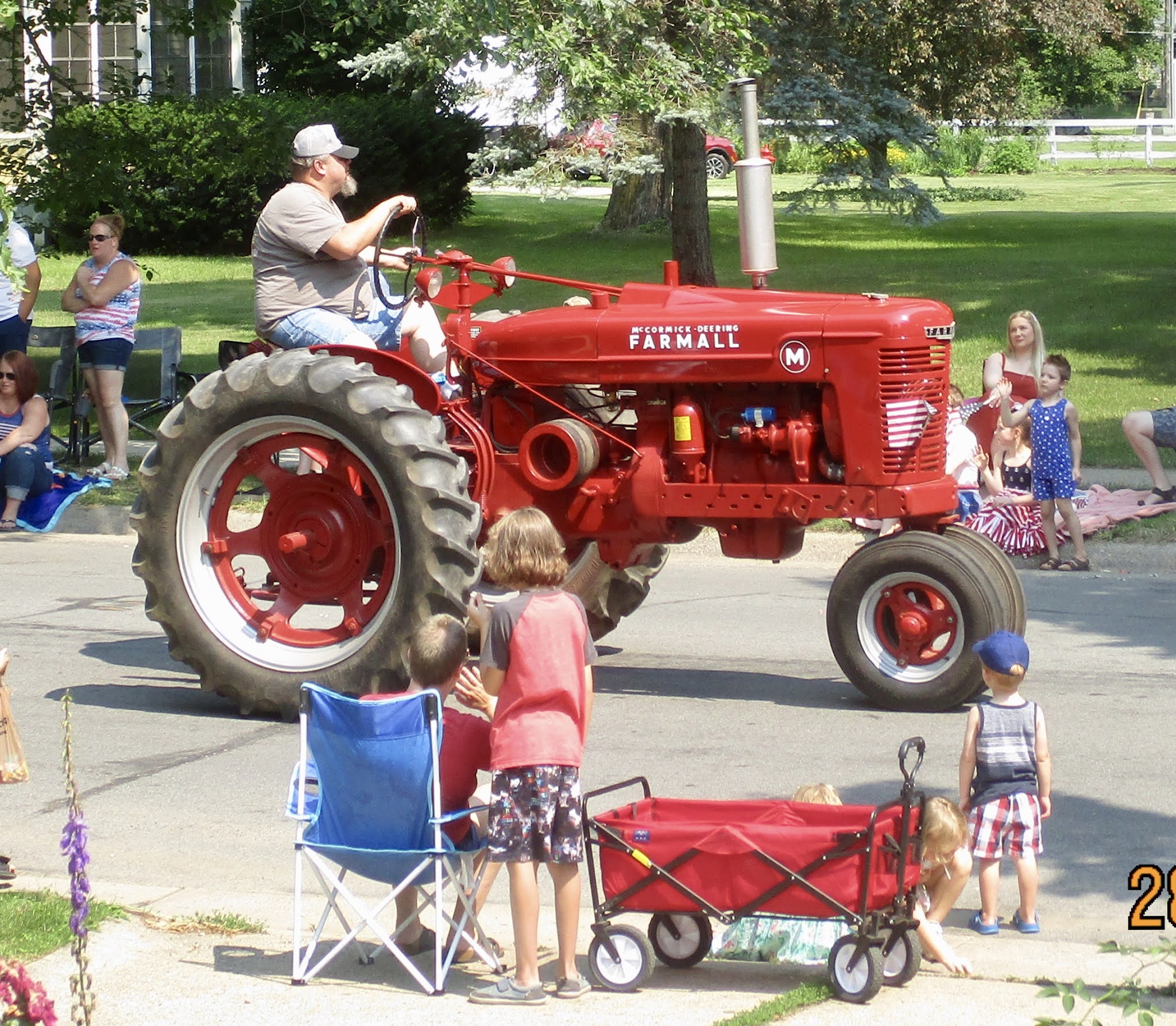
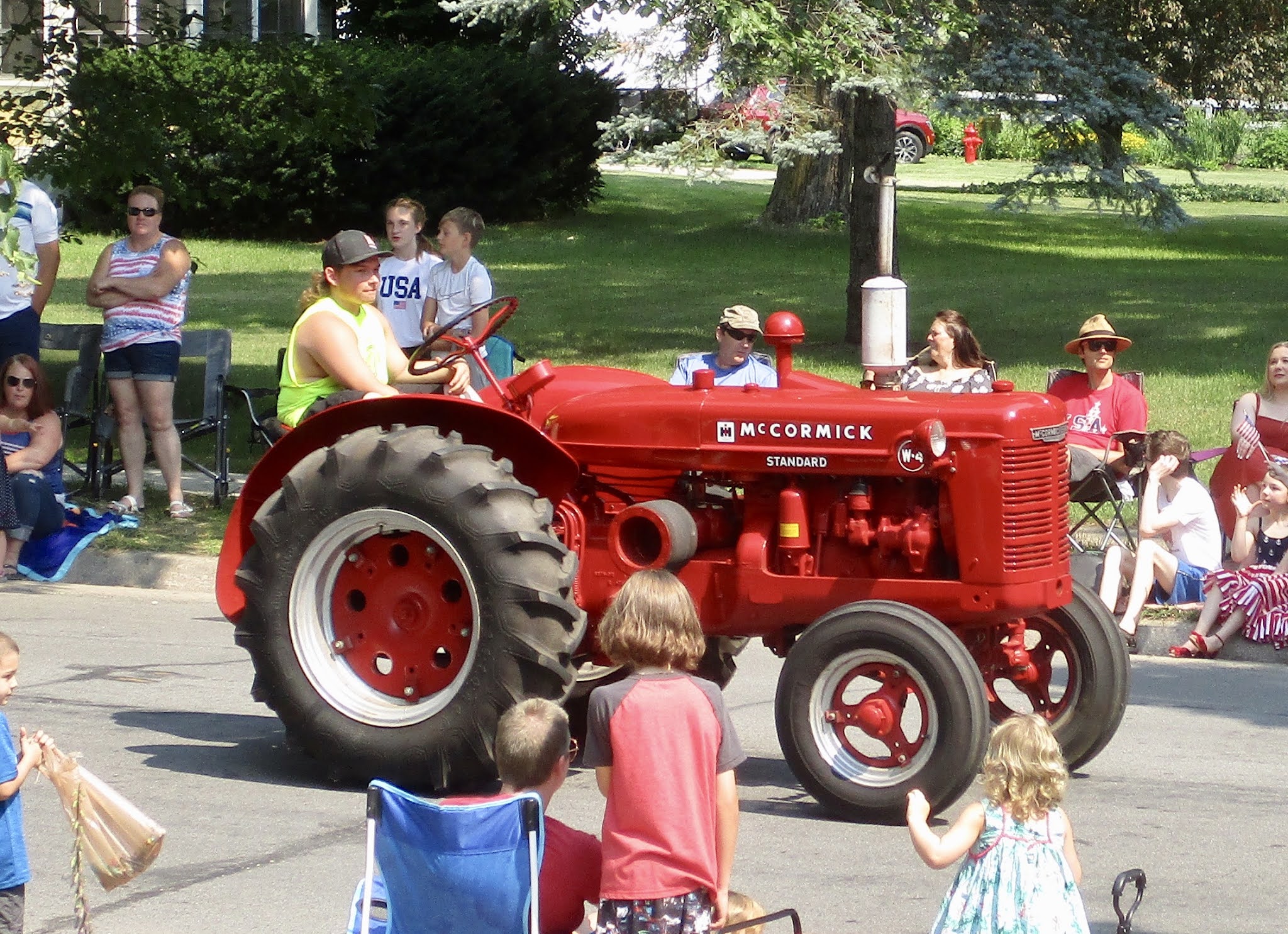
    Our parade has tractors.  Many, many tractors.  Vintage tractors are lovingly restored in these parts.  You'll notice that there isn't so much as a hint of mud or soil on those tires.  When going on parade, they tend to group themselves by their make, like Hogwarts houses.  


A  B.F. Avery tractor.  Note the hand crank in front to start it.
                                                                                                          An Allis Chalmers tractor


A Farmall tractor.  I particularly like the little boy at the bottom right who is absolutely enraptured with it.
                                                                  A McCormick Standard tractor

The much beloved John Deere tractor.  John Deere tractors are green and yellow precisely because other tractors weren't.  An old John Deer ad said it was "as familiar as the green of cornstalks and the gold of ripened grain."  I didn't know this, but the color of a tractor is called its "livery."  As a neo-Victorian, I find that charming.  


    In prior years, the littlest tractors of any given make (about the size of a riding lawnmower) would lead a line with each tractor larger than the one before it until, in some instances, the final piece of farm machinery would take up both sides of the street and kiss the branches of the trees along the way, sending showers of leaves into the crowd.  Then the next group would do the same for their maker.  Our compliment of agricultural monstrosities was somewhat diminished this year, but I hope for better things next July.

       We also have a few oddities in the parade as well.  According to the rider's sign, this is a 1935 John Deere "water cooled hit & miss engine ice cream maker."  The rider is a Korean War vet.  This is something you will never, ever see at the Rose Bowl Parade. 


 We have vintage cars.


And the Lion's Club had a float with, you guessed it, a lion on it.  


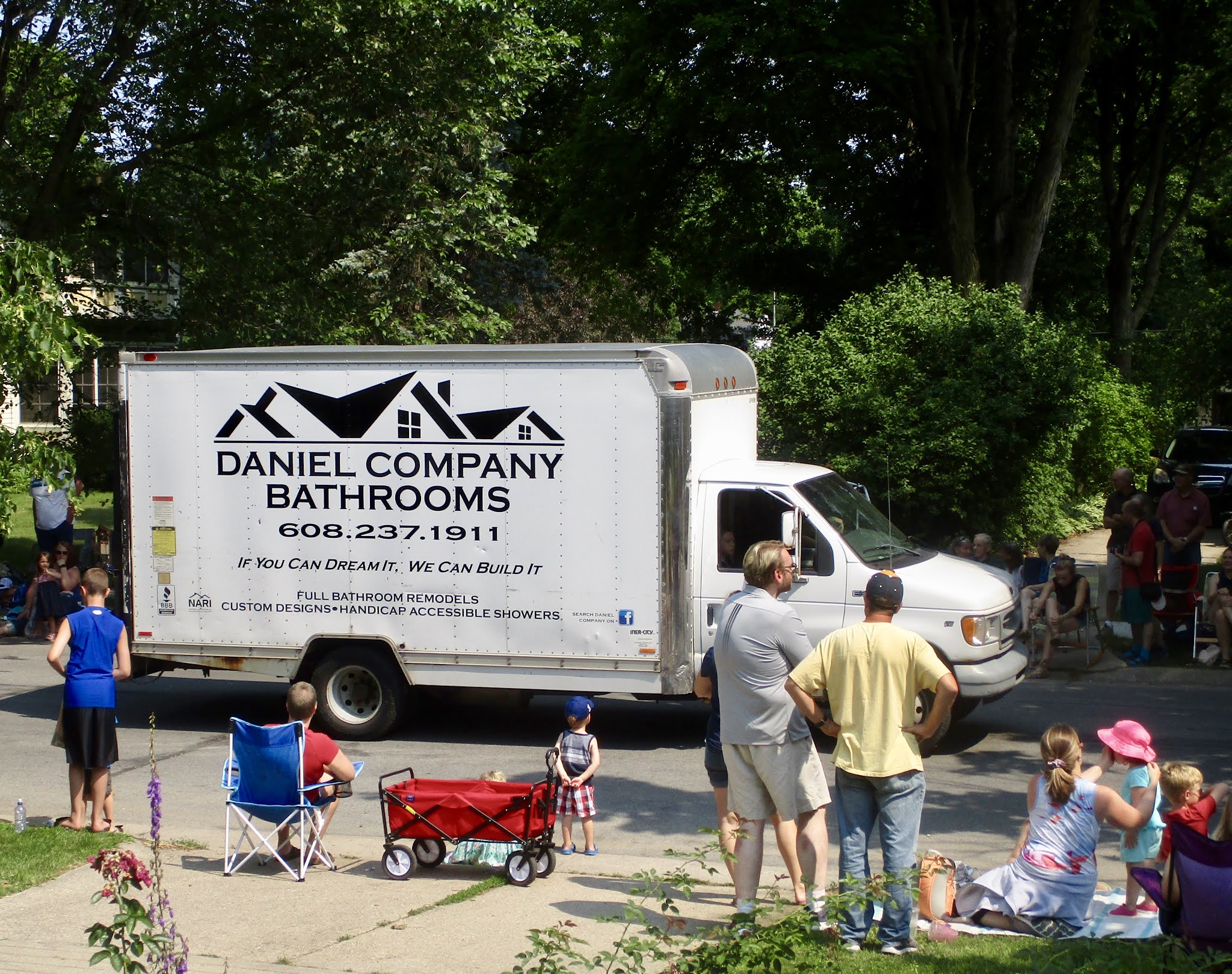
  Evansville's Fourth of July parade is unique in its ability to combine the patriotic with the practical.   As flags fly and horses clop by, the parade watchers are treated to a variety of rolling advertisements such as an asphalt truck with the company logo prominently displayed.  Or the local grain elevator sponsoring a float.  Subway will often have a dancing sandwich trotting down the street, and our local large-scale dairy always has a walking cow beside its vehicle.  And they throw yogurt pops.  There were two striking examples, however, that must be shared:
                                        This took me by surprise, but then there was this:


    Why, yes, that is a full-sized bathtub with shower (and shower curtain rod even) decorated with flags being pulled down the street.  What else could one wish for?

    And after a long parade, the last to come are the fair lads of the Evansville Jays, our hometown baseball team.  They play a game on July 4th every year at Lake Leota Park.  I'm not a sports fan by any means (it's nearly heresy to say that in Wisconsin), but it's great to live in a town with its very own baseball team.    

    And all of this rolls right past my front porch where I can sit and have tea and watch the parade pass by.


*My apologies in getting this post up late.  The process of sorting through dozens of photos was a bit daunting.  Happy 4th of July, everyone!


August - Peaches, Tomatoes, and Flax - Oh, my!     August this year seemed like a month suspended in time followed by an insane rush.  After...